Body Language: Photographs by Thomas Kelly at the Rubin

Thomas Kelly, Smoking Sadhu (2000)

Body Language: The Yogis of India and Nepal, up through July 4,  is a fascinating photograph exhibition in the lower level of the Rubin Museum of Art with prints by Thomas Kelly, an American photographer who has lived and worked in Nepal for many years. This collection of images documents wandering Hindu ascetics called Sadhus, and notably these men and woman paint their bodies in striking colors as they emulate their chosen deities. The Rubin Museum provides context on these remarkable looking people in these beautiful images of naked and painted people with matted hair. The exterior is just one way in which the Sadhu takes on the attribute of the deity he is emulating, which becomes the goal and process of his whole life.

Installation View of  Body Language, Rubin Museum of Art

Kelly writes on his website of sadhus in respect to his book Sadhus: The Great Renouncers:

In my adopted home of Kathmandu, some sadhus survive primarily off alms made from allowing tourists to photograph them. They are a spectacle and love to play their assigned role in the illusion or drama of society. Their masks are thickly painted on their naked bodies. Sadhus have formally abandoned conventional time; their world is dense with its own complex politics, social hierarchy, taboos and customs, often making access challenging.

Volatile and unpredictable, spontaneous photography of sadhus can actually be dangerous. You can easily be trampled or attacked if you immerse yourself in a naga baba procession after a mass Khumba Mela bathing. Or, without permission from a Mahant to work inside an Akhara, be accused of being a spy and have to answer to a Sadhu tribunal. There’s no such thing as achieving photographic acceptance within the Sadhu mandala. For me, photographing at ritual time is always the most dynamic and fluid. Once rapport has been established, a camera is tolerated, often with a sense of lila, or maya, play and illusion. It took repeated visits over many seasons and melas, to occasionally reach this level.

My initial inexplicable attraction to the Sadhu world was mostly visual. As a photographer, I loved how they allowed their bodies to become symbols of the sacred- from walking around naked to remind us of our naked selves, to wearing ash to remind us what are bodies become, to dreadlocks to remind us of our natural wild natures devoid of social convention. Their bodies were texts, which spoke volumes regarding sacred symbolism.

A sadhu’s body is a map of the Hindu universe, for the body is a microcosm of the cosmos. Like a canvas, the colour and painted symbols aid in purification, inspire, and remind of the timeless divine beyond body and form. The body is used to tell stories. As the sadhus works towards an egoless state, he becomes the very symbols he’s painted whether it be Shiva, Vishnu, or Rama, the colors refer to esoteric inner visions and possible alchemical states of consciousness. The real goal of a Sadhu is to achieve an attitude of non-attachment and transcendence of the physical body.

Body Language: The Yogis of India and Nepal is on view at the Rubin Museum of Art through July 4.

Stoppard’s Arcadia on Broadway

Picture of the ending waltz (NOT from the current Broadway production)

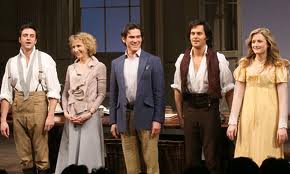
It all ends in one swirling waltz, with both past and present people circling each other in a ring of time and thought. Indeed, Stoppard’s Arcadia, currently running at the Barrymore Theater, gives the sense that time dances with itself as well. The two intertwined narratives, one in the 1830s and one in the present day, step around each other in the space of an old British country house, never touching except perhaps if the present day inhabitants feel a ghost-like chill as they research the earlier characters.

Aptly played by most of the cast, except perhaps a really galling and annoying portrayal of Bernarad Nightengale by Billy Cudrup that toned itself down in the second half, the lines were spoken well. (The NY Times disagrees here.) Stoppard loads his lines down with so many -isms that are then undercut by so many comedic lines that just getting them out naturally and so that the audience can follow deserves applause. The characters themselves are warm and human, if not particularly fleshed out. In their limited roles, the mouthing of Stoppard’s suddenly heart-wrenching epigrams, full of yearning and paradox, can seem a little startling.

Many of Stoppard’s plays have been history lessons as well, bringing us into the intellectual thoughts and mores of an era. Nothing revolutionary happens here, and a quick explanation of plot or purpose is hard to come by for Arcadia. Set in Sidley Park, an English country house, the research of two modern scholars and the house’s current residents are juxtaposed with the lives of those who lived there 180 years earlier. In the present, writer Hannah Jarvis is researching a hermit who once lived on the grounds of the estate and Bernard Nightingale, a literature professor, is investigating a possible connection to the life of Lord Byron. As their investigations unfold, helped by Valentine Coverly, a post-graduate student in mathematical biology, the truth about the 1800s era residents Thomasina Coverly, the daughter of the house, and her tutor Septimus Hodge, is gradually revealed.

What the actors do very well is make the search for knowledge and truth a passionate, heartfelt affair. The possible futility of it lends pathos to the character’s individual searches. Time and Sidley Park brings them together for a brief moment. Altogether, a little wilder than the average Bristish country house story.

Tete casquee

Tete Casquee, 1933. Bronze

My favorite piece from the Gagosian Picasso and Marie-Thérèse: L’Amour Fou exhibition seemed to have little to do with Marie-Thérèse: the Tête casquée (1933) bronze head of a warrior is charming, a little goofy even, but fantastic. (It is also apparently under copyright protection in the US, because heaven forbid my blog show a small, low-res image of a famous Picasso sculpture without a ‘gettyimages’ tag over it. I mean, we all have to keep our standard up or soon the rabble would be sharing images of god-knows-what important sculpture.)

Luckily MoMA is a little freer with an image of a plaster cast of the same work, which shows the wonderful face of the soldier better:

Head of a warriorBoisgeloup, 1933. Plaster, metal, and wood
I hope the inclusion of this piece wasn’t meant to be a riff on Marie-Thérèse‘s Roman nose?