Ravels in Review

This week will no doubt go down in your minds and blogger history as being that of my birthday. Good–please remember that next May 26.

  • As I learned in doing historical research, historically few great things have happened on May 26 aside from my birth.
  • I wrote about my experience buying art (none) and some of the difficulties of buying art on a budget. Just a note: the gallery called my boyfriend back yesterday to say that the work in particular that I had liked was available.
  • The Hernan Bas show at Lehman Maupin predicts the future to be lush and lonely, and that says a small part of how much one could say about the artist’s most recent paintings.
  • Lastly, I was so struck by an old book that accidentally came into my hands that I had to share the artist/author Eugene Fromentin’s extremely dated travel book of Dutch painters with you. He is in rapture over Rubens and Rembrandt. Hero worship like his doesn’t exist anymore in criticism, maybe to our loss.

On the other hand, Fromentin is not so kind to his contemporary (1870s) art scene in France. The Impressionists, apparently, have no sense of value or line or color, and only Corot and Delacroix are worthy of respect. In fact, let me leave you with a few more of his words;

Landscapes make every day more proselytes than progress. Those who practise it exclusively are not more skillfull in that account, but there are more painters who try it. Open air, diffused light, the real sunlight, take today in painting, and in all paintings, an importance which has never before been recognized, and which, let us say it frankly, they do not deserve.
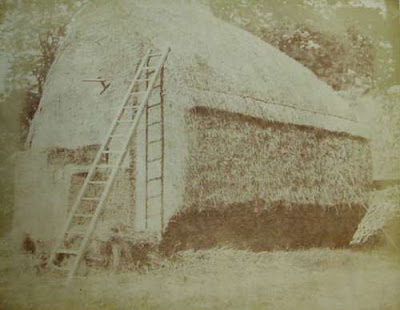
Photographic studies as to the effects of light have changed the greater proportion of ways of seeing, feeling, and painting. At the present time, painting is never sufficiently clear, sharp, formal, and crude.

The abuse of useless roundness has driven into excess flat surface, and bodies without thickness. Modelling disappeared the very day when the means of expression seemed best, and ought to have rendered it more intelligent, so that what was progress among the Hollanders is for us a step backward; and after issuing from archaic art, under pretext of new innovation, we return thither.

Hero Worship is Passé

Falcon Hunting in Algeria, Fromentin

Eugene Fromentin‘s The Old Masters of Belgium and Holland sounds more like a textbook than memoirs of an artist’s 1875 trip to Holland to see Dutch paintings, which is why I borrowed it from the library. I quickly discovered my mistake. It might sound charming, but this book is actually full of long-winded, vague descriptions and similarly long, vague rhapsodies over the genius of Rubens and Rembrandt. (With some sleights to the new Impressionist school in France.)

Fair enough, you might say. Rubens and Rembrandt are generally thought to be great and important painters. But when I say rhapsodies I mean full-blown, adulatory praises ala:

that morose and witty dreamer, who without living apart had no relation with any of them; who seemed to be painting his epoch, his country, his friends and himself, but who at bottom painted only one of the unknown recesses of the human soul. I speak, as you must know, of Rembrandt.

[Rubens] fills the last division of the gallery, and there sheds abroad the restrained brilliancy, and that soft and powerful radiance which are the grace of his genius. There is no pedantry, no affectation of vain grandeur or of offensive pride, but he is naturally imposing.

Hero worship of this sort if dead. In every artistic field, we practice new forms of criticism that analyze structure or context or socio-political aims. Anything but pure, old fashioned worship. We use more naunced words that genius, and we certainly don’t assume the great art stems from souls of great moral worth, as Fromentin does. He sees valour and searching wit and genorosity of spirit in the lines of Rembrandt’s drawings. I see lines–and maybe it is my loss.

Arabs, Fromentin
Fromentin was no great critic, not like Matthew Arnold or Baudelaire who practised and preached. But when it the last time you read a review that put the artist on a pedestal? We treat artists as cultural specimens to be dissected. The only critic not afraid of the term genius is annoying Harold Bloom, and I suspect that’s only because he wants to be able to include himself in his self-defined pantheon. I wouldn’t mind hearing a little simple admiration. I don’t mind the damming reviews, as they tend be better written and more intersting. Yet with all the snark floating about, earnestness can seem almost too exposed, too simple.

Maybe more appreciation would be appropriate. That is what moves us to write about and talk about these things in the first place.

The Future is Lush and Lonely: Review of Hernan Bas at Lehman Maupin

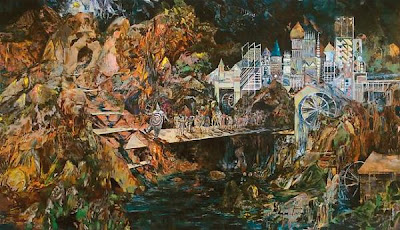
Hernan Bas’s show at Lehmann Maupin, up through July 10, is many things; the first adjectives that come to mind are worth-seeing, interesting and ambitious. These scenes of verdant landscape enclosing small figures create a sense of narrative, cataclysmic and lonely, and are visually mesmerizing as your eye tries to take in all the detail of these large canvases.

Ubi Roi

Bas breaks up the landscape with angular planes and covers them in expressive brushwork. There’s a chaotic element to the landscape, which looks like tectonic plates smashing into each other to create contours, and its warring colors.


While the angular planes of the landscape are lushly and loosely painted, this contrasts with his treatment of human figures. They are small in relation to the landscape and tightly delineated. His figures are the more telling than his deceptively loose, chaotic landscapes. You can see it in the hard edges he creates, seemingly by painting in layers over strips of paper that he then pulls off, how precisely controlled the enviorns are.

A Landscape Heard

Bas’s images work from far away, when the wild colors seem more balanced and you get an evocative sense of a landscape in ruin, and up close, where his painting becomes mesmerizingly complex. There are some instances of really beautiful color, like below. Yet I also felt that the angular planes of the landscape, instead of creating depth, pushed everything in the picture to the forefront. Without depth, the complexity becomes dizzying, at times to the composition’s detriment.

As Bas says in an interview with BlackBook,The whole show is based on a newfound interest that I had in Futurism and 1920s Absurdist performance,” and there’s no lack of references to it within the show (e.g. The title of the show, The Dance of the Machine Gun & Other Forms of Unpopular Expression). This conscious use of art history can seem heavy handed, and I think the New York Times might have put it best when, in an article on the artist’s show at BMA that just closed, “The cumulative effect of the exhibition is of a young man still finding himself as an artist.”

The Bagpiper in Exile (or, The Sad Wind)


‘Finding himself’ seems to be a rewarding process for the viewer as well as the artist based on this show. It bodes well that the artist is willing to try new things, as here he to incorporate new elements into his visual language and risk different subject matter (previously homoerotic scenes of young boys, like the show at BMA). Bas is an artist to watch.

g