It’s Official: I’m lovely

The word ‘lovely’ begins with an affecting root noun and adds an adverbial -ly to make it a descriptor. It’s a generally nice word that I’m rather fond of. All the more so when it is applied to none other than myself. Anna, the around the way girl, an ‘editrix’ who covers things sartorial and all around the way, plus some great images, gave me my first blog award.

Here are the rules:
1. Add the logo to your blog.
2. Link to the person from whom you received this award.
3. Nominate 7 or more blogs.
4. Leave a message on their blog, letting them know they are One Lovely Blog!


Step 3–oh dear, I read almost a hundred blogs. Obviously, I read them because I like them. They’re on hundreds of topics. Should I only mention great art blogs? Should I mention the ones that fit ‘lovely’ best? I finally chose the blogs written by people I would like to know based on his or her personable, lovely blog (da da dum):

  • Boredom’s Bounty: For the Love of Pictures takes pictures of her life in NYC and posts them every day. I like pictures, I like her stories. Like real life here, they aren’t all of the Empire State building. I see it and I think, ‘I should do that.’
  • The Blue Lantern: Jane not only works for NPR (cool), she writes arts journalism for the love of it. But she attacks it an a culturally voracious way that will take you from painters and design to hedgehogs. You must see the hedgehog post. Delightful.
  • The Age of Uncertainty: A lovely blog by a lovely man in Steerforth, England. You’re all free to be madly jealous of him, seeing as he recently took on an amazing job where he gets to sort through old books all day looking for gems.
  • Little People: A Tiny Street Art Project: OK, so this isn’t a person. The blog is of a series of miniature human figures placed around London in ways that create the most endearing and humorous storylines. It always a pleasure. Scroll down the page a bit to some great images like Crappy Christmas or Last Chance to Impress.
  • Wurthering Expectations: A new find, this blog is by a reader whose voraciousness surpasses mine. He is storming the bastions of English literature, and his blog might be a good refresher course for those of you who miss you old Victorian lit class. (Granted, I might be the only one who feels exactly like that.) The blog is lovely for many other reasons, as I’m sure you will see for yourself.
  • Under Construction/Art Contemplations: Bill is a blogger who knows about Medieval witch hunts AND art. Quite the combination. An artist himself, he shares his own work on his blog too.
  • The Lusty Reader: OK, the girl likes her Romance novels. I like the Romantic movement. So aside from a love of reading in general, we have little in common. Thus it says a lot that I enjoy reading her blog as much as I do.

Aside from my lovely blog award, what’s new with Art Ravels you might ask? Actually, let me frame that as a series of questions directed at you, dear Reader.

  • Is it true that you have to floss your teeth twice a day to prevent cavities? I floss mine once a day, which seems like more than enough, and my dentist told me I need 4 fillings from not flossing. REALLY?
  • How do you keep voracious, herb-eating, pepper-popping, all together EVIL birds out of your container garden? They have nibbled my mint to stubs in a matter of days, the basil looks depressed, and the oregano is diminishing at a rapid rate. I’m afraid the sage and thyme are going to walk out of the planter in protest. And don’t even get me started on the topless hot cherry bomb. (a plant, people, a pepper plant.)
  • If you are driving a taxi in midtown rush hour traffic and you see a biker in midtown biking in a straight line down the bus lane, do you speedily pull in front of him and stop to pick someone up? NO! No, you do not endanger said biker’s life. You take the extra 90 seconds to pull in behind them. May you heed the safety warning before said biker with a lovely blog becomes squashed.

In sum; dentists lie, birds are evil, and bikers must not be driven over. On the upside, Art Ravels is a lovely blog and so is my ride along the East River park before I hit Midtown.


Sophie Calle’s Take Care of Yourself (I’d Rather She Didn’t)

I did not want to write about the Sophie Calle exhibition at the Paula Cooper gallery. Then I read this piece in Interview magazine, and thought Calle’s dialogue with interviewer Louise Neri so interesting it should be shared. For background, Calle was emailed a break up letter ending with the phrase ‘Take Care of Yourself.’ The artist did not take well to the phrase, and sent the letter to be interpreted by 107 women in different professions. They cry, they rage, they analyze, they dance and one even teaches a parrot to repeat, “Take Care of Yourself” over and over. This work first appeared at the Venice Biennial in 2007.

SOPHIE CALLE: The rules of the game are always very strict. In Take Care of Yourself I asked the participants to answer professionally, to analyze a breakup letter that I had received from a man. The parameters were fixed. For example, I wanted the grammarian to speak about grammar—I wanted to play with the dryness of professional vocabulary. I didn’t want the women expressing sentiment for me. Except maybe my mother . . .

NERI: Yet, typically, she was one of the least sentimental! [laughs]

CALLE: I have my own sentiment—I don’t need that of others. This work was not about revenge. Even so, all the women spoke from their own points of view and, probably, many of them had been abandoned by men at some point in their lives.

Note: When this subject was brought up at the lovely art salon I frequent, 3 of the 5 women present had received an email break up message. None of the men had. Those women tended to be more accepting of Calle’s exhibition, though I don’t believe any had seen it. When I saw it, I was struck by the sheer volume of items in the exhibition, but didn’t gain any insight into Calle or heartbreak. In anything, it made everything seem senseless.

NERI: Louise Bourgeois once said that art allows you to re-experience the past in a proportion that is objective and realistic. I could say the opposite about this work because one letter gave rise to an entire universe of response and nuance. It’s both a torture and a tribute!

CALLE: Yes! At the beginning, one of the titles I had in mind was “The Muse,” because this man was, in fact, a muse. Finally I didn’t, because “Take Care of Yourself” was more ironic. And, more strictly, it’s what I did.

NOTE: I rather like the idea of the man as a muse. But if you are a muse to so many women, why is Calle the artist? Because she was broken up with? Because she collected the responses? Because she arranged them on the gallery wall?

CALLE: It’s true that when I speak in public, everyone asks me about life and I always have to bring them back to the fact that it’s a work of art. The difference with many of my works is the fact that they are also my life. They happened. This is what sets me apart and makes people strongly like or dislike what I do. It is also why I have a public beyond the art world. I don’t care about truth; I care about art and style and writing and occupying the wall. For me, my writing style is very linked to the fact that it is a work of art on the wall. I had to find a way to write in concise, effective phrases that people standing or walking into a room could read.

NERI: At times, art struggles because reality can be so overwhelming . . .

CALLE: Art is a way of taking distance. The pathological or therapeutic aspects exist, but just as catalysts. I didn’t make Take Care of Yourself to forgive or forget a man—I did it to make a show in Venice. The show came to my mind because I was thinking, What can I do to suffer less? But once I got the idea, it took over, and I didn’t care about the therapeutic aspect anymore.

NOTE: The confluence of art and life that she speaks about in the first quote reminds me of Lord Byron and Oscar Wilde and all the accompanying questions of truth that stalked them. Calle, like those lovely men of mine, makes me feel as if she knows that she is manipulating her audience and she knows that the flux between art and life has brought more fame than she would have had otherwise. When Calle then explains how she uses her pain as a catalyst for the Venice Biennial, it seems cold and contrived.

CALLE: I never had victims. Well, there were only three cases, twice with lovers: Exquisite Pain and Take Care of Yourself, and The Address Book.

NOTE: Calle has a history of exploring intimacy in ways that might violate one’s notions of privacy, and it’s pretty fair to call her anonymous ex a victim here.

Whether it’s revenge or a way of working through something, the exhibition feels like its meant to tug at heartstrings rather than create an aesthetic object. The artist did little more than stage a scenario and collect responses in an way that feels like overly-pointed rhetoric. Whether the exhibition is heartless manipulation or angsty literalness, it doesn’t remain visually interesting enough to keep my attention. It merely poses as art.

Photography Everywhere: Avedon to Leibovitz

The Model as Muse exhibition is up at the Met, a show of photographer Richard Avedon’s work will be up at the International Center of Photography as of Friday, and I’m reading Annie Liebovitz’s At Work, a biography of her photographic life. So photography is on my mind.

Avedon, as you can see above, is know for breaking up the static, staid poses used before and introducing movement and energy. ICP also says he anticipated “many of the cultural cross-fertilizations that have occurred between high art, commercial art, fashion, advertising, and pop culture in the last twenty years.”

This brings us to Leibovitz’s body of work quite concisely.
Fashion, check.
Commercial art, see litany of Rolling Stone, Vanity Fair, and Vogue covers.
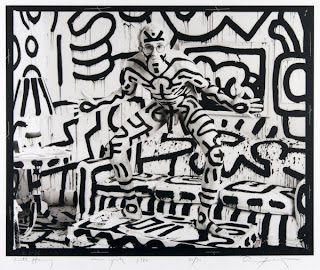
Fine art, see image above of artist Keith Haring dressed as his work.
Advertising, check.
Her career began in art school in San Francisco. In her third year, she began taking photographs for Rolling Stone magazine, then a small publication. She worked with them for years, going on tour to take photos of the Rolling Stones and taking the last photos of John Lennon before he was assassinated.

Later she came to New York to work for Vanity Fair, and it was only then, between fashion and political shoots, that she begun to consider doing advertising. Before she had always been held back by her fine art background and her difficulty photographing to someone else’s standards. The advertising she did end up doing was a series a black and white portraits of famous people for American Express–one where her creativity was allowed to come out. That was the beginning of many successful advertising campaigns–and you get the sense Leibovitz never let her creativity be trampled upon. (Of course, as one of the biggest photographers of her day, she does had some clout.)

TeedleDee and TweedleDum with Alice from the Alice in Wonderland series

Chuck Close, artist, as the Wizard of Oz

Looking back over her work, the photographs I still enjoy most are from some of her more imaginative fashion sets. She does fantastical storylines with clothes to match, like the ones above. She has a range of different, innovative work and her portraits wonderfully capture a range of interesting personalities (including Queen Elizabeth of England). The collection of her photographs in this book show someone who had been in touch with pop culture and made more of it and who has seen people and done more than document them, she exposes them.