Ray Caesar and Ugliness with Beauty

Recently I came across the works of Ray Caesar (feel free to check out his very nice web site from which I pulled these). I think the images are lovely: striking and rich palette and a painterly feel (as it happens, the images are produced digitally). The images are often of beautiful fantasy women, typically in romantic period costume and in luxurious, ornate settings…with deformities. Not deformities that actually happen to people, but like the one to the left: octopus-like tentacles. The combination of the beauty of the style, which suits the preconceptions of beauty we bring to glamorous women in Victorian costume, twists the ugliness of these unexpected, unnatural additions into an uncanny mix. In some of his more explicitly sexual works, there is the added odd charm of liscentious and uncanniness and beauty. The effect: disturbing.

Distrubing in a light way, the kind you never need think about twice. The uncanny, as a mix of ugliness and beauty, is ground mined during Romanticism and liscentious ugliness reared its serpent head in the works of Decadents. The mix of straight-laced Victorianism with alien qualities is nice, the skill of the graphics excellent, and the style beautiful. The dreamy Surrealism of Dali, as well as similar plasticine molding of form is “pretty,” as in attractive.

But what interest me is the use of prettyness and ugliness together. Does the style beaut-ify the ugliness depicted? Does Caeser succeed in making beautiful pictures of uncanny, ugly things? I think so. But I think that is the sum total of his charms, and there is much more to be said for ugliness in art. For example, can it be ugly, if it’s good art?

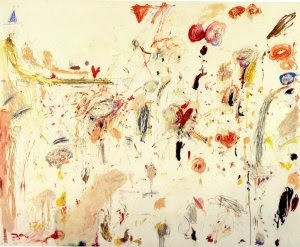
Cy Twombly and Tara Donovan: Connections

Tara Donovan’s recent exhibition at the Metropolitan Museum of Art awakened me to how lovely and natural her sprawling forms can be, making me quite pleased she won a MacArthur “genius” grant. Composed of a single type of “ready-made” material, she deconstructs the material until you see the essence of its structure and qualities in the way she presents it. She uses mylar tape on the walls of the Met, tacking the shiny rings across the walls like the natural growth of fungus or barnacles. The photograph (below) gives you no true sense of the feel of the

walls, or the gloss of the transformed mylar. Donovan both brings the material into its essence, and gives it a new identity. The way she organizes her material, as one can see here, is organic and expansive, holistic in a way that encompasses chaos. I find the subtle, minor variations of the patterns of rings trance-inducing.


Let’s take another contemporary American artist, Cy Twombly, who I feel is more similar to Donovan than is immediately apparent. Wikipedia categorizes him as “well known for his large scale, freely-scribbled, calligraphic style graffiti paintings; on solid fields of mostly gray, tan, or off-white colors.” For both artists, scale is large. Twombly’s abstract paintings create similar designs whose internal harmony mimics that of nature.

Obviously Twombly is quite painterly and messy, and Donovan has a clean-edged, minimalist aesthetic to her sculpture. However, the works of both display a harmony through sprawling, organic balance in patterns echoing Donovan’s work above. Both artists use organic arrangements to evoke a chaotic materiality. Their works are atmospheric, rather than explicit, and scattered rather than centered. What they are saying about the world, even in Twombly’s paintings where he writes it out, is unclear, but how they say it is tantalizing.

Great Theft

Art theft is rarely sordid, rarely violent. It is, in fact, a rarified and cultured kind of crime, one that every aesthete, in the darkest cockles of their hearts, admires. That lusty feeling that seeps into one’s bones as everyone else passes on like shadows while you stare at that thing—that marvelous thing—that seems to have sprung like Athena fully formed from your head, that feeling if why art is stolen. Sure, you might cry, but what about money? What thief could care less about the cold, hard cash a thing is worth?

Exemplia Gratis: Stephen Breitweiser. This young (not to mention, rather attractive) Frenchman lived in his mother and worked as a waiter for 10 years. He and his girlfriend often went on weekend trips to the ancient castles and house museums of Europe. Meanwhile, he was was collecting, via duplicitous mean, 16th and 17th century European masterpieces. In 2001, he was caught attempting to steal a bugle, one of only three like it in the world and with an estimated value of £45,000, in Switzerland. But it was only when he came back two days later to try again that he was arrested.

In his trial, he admitted to stealing 238 artworks. Why? According to Wikipedia, he said at his trial, “”I enjoy art. I love such works of art. I collected them and kept them at home.” Despite the enormity of his collection, he was still able to recall every piece he stole. He interrupted the lengthy reading of his collection during his trial several times to correct various details.” What more noble motive for theft than a love of beauty. The illguarded, barely visited museums dotting Europe have their share of visitors no doubt, but who loved those pieces as he did. The desire to posses each one must have been an all-consuming passion. How often does an indivudal fully realize one’s passions? His success ought to be commended and held forth as exemplary.

Instead, Breitwieser was given a 26-month prison sentence. While that is the unfortunate outcome of gambling with society’s laws, the real loss—and no doubt the one the Stephen himself felt most—was the loss of the paintings. Over 60 paintings, including masterpieces by Brueghel, Watteau, Francois Boucher, and Corneille de Lyon were chopped up by Breitwieser’s mother, Mireille Stengel, in what police believe was an effort to remove incriminating evidence against her son. And really, for such a man, is that in itself not punishment enough?

Even more laudable is the theif’s attitude toward the whole debaucle. Capitalizing on his capture and new-found notoriety, he wrote a book.