 Byzantine Grid, 2005
 Fabric is feminine. Despite the male tapestry makers of the 17th c. or the male weavers of the 19th c., fabric is associated with the feminine and the decorative (i.e. lesser) arts. Long overlooked, textiles, such as quilts and embroidery, have only recently come to prominence as an art form spurred by the acceptance of crafts as artwork and the nudge of the feminist movement.
 Detail of Byzantine Grid
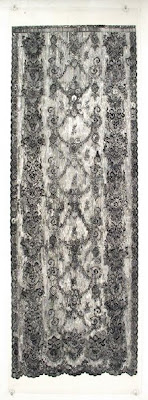
Byzantine Grid is a traditional brocade, except that instead of being woven, it has been painted with thousands of tiny strokes to imitate an aged piece of cloth. At 90 inches high by 180 inches wide, it’s larger than the wall of my bedroom. While it’s detail and delicacy cuaght my eye, I also like how the artist deconstructs a ‘feminine’ art and remakes it as a fine art piece.
It makes a statement as it hangs in the gallery, one about women remaking patriarchal tradition in their own, modern way to create an object that demands to be placed next to the Jackson Pollacks of the world. Friedmann deconstructs traditionally feminine crafts of lace making and fabric, even while playing into traditional ideas of the feminine. These images of Friedmann’s work are from 2003, but she has more recent work based on fabrics on her website. Check out the small works from 2005.
She Muttered, 2003
 According to the artist, “I manipulate symbols that deal with ideas about femininity and the role of women in art history. I draw and paint and present these issues in an over the top gorgeous way. Among some of my interests are Spanish colonial art and Minimalism. I paint some of the things that women have been historically associated with, like flowers lace and embroidery. I monumentalize them and give them a heroic place and scale that can remind one of high macho modern art.”
Friedmann is hardly the only feminist who has reclaimed textiles as part of the fine arts. Along with many of the decorative arts, textiles have come to the forefront as ignored crafts with a visual language that has been ignored up until recently. The new Museum of Art and Design at Columbus Circle would hardly have been possible without this emergence. My posts have a bit of a feminist slant lately, but only because you see these things everywhere once you start looking. And by things, I mean beautiful and interesting objects and people.
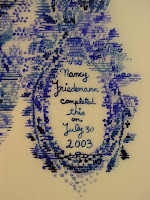
 Detail of She Muttered, 2003
 I sat watching a play, in the leftmost corner of the gallery where a chilly draft plagued me, for over 2 hours. It wasn’t torture to be cold, and an angle that wouldn’t suffice for TV watching or Internet surfing was somehow worthwhile for the stage. At the end of the play, like a bunch of trained monkeys, everyone watching hit their hands together to make a slapping sound. Why do we clap? How is it more civilized than howls or stomping? It signifies our enjoyment, but what is this quality of aesthetic enjoyment–this dreamy break from reality that takes on the guise of reality? Why is a simulacrum of reality more pleasurable to watch than the thing itself?
 We are a strange animal.