Self-Portraits from James Turrell’s show at PaceWilderstein

Art Ravel’s 2009 Prize for Best Artwork to Take Self-Portraits With goes to…
James Turrell at PaceWildenstein


Remember holograms? They were big in the 80s. Anyhow, these seemingly 3D depictions of color by James Turrell make awesome backdrops for photographs. Awesome.

I actually saw quite a lot of abstract color when I went to Chelsea on Saturday, and this might be in a sense the purest form of it. Or it might be the transference of abstract Minamalist principles to a new medium (which seems not nearly as high-tech as it did in the 80s).

This jpeg on the left doesn’t really do the work justice either; the shifting work creates a experiential process of looking that is hard to capture. In case you are really into holograms, the show is up at Pace’s 25th St location through October 17th. It could potentially be a soul searching experience in which you touch the miraculous essence of color and exit a changed being, but most likely any reveries you have will be interrupted by inspired photographers like myself whipping out their camera phones. Maybe try to go when the gallery is less busy. : )

NYC’s Wealth of Vermeers

The Milkmaid, 1657, Rijksmuseum, On loan at the Metropolitan Museum of Art

The economy may be dismal, but New York is still rich in some things: people, MTA delays, and- thanks to a generous loan from the Rijksmusem- Vermeers. The Met exhibition Vermeer’s Masterpiece, The Milkmaid is open until November 29, and rarely has an exhibition been so well devoted to one picture. It provides a context and education for Vermeer’s masterpiece with a slew of exceptional Dutch paintings. The Milkmaid itself is more beautiful than I knew to expect. I saw the exhibition last night and was blown away by it. I’m going back, and I suggest that you see it and take a detour to the Frick as well.

The exhibition at the Met boasts 6 Vermeers. In addition, the Frick Collection, which was unable to loan its paintings for the Met’s exhibition, has another 3 paintings by Vermeer. Currently in an afternoon on the Upper East Side a person can give themselves an education on Vermeer with 9 of his 36 existing paintings. Not bad for a recession.

The nine paintings below are even lovelier in person (except the Study of a Young Woman–would love to hear what you think of that one). They are arranged in chronological order, the first having been painted a year before The Milkmaid.

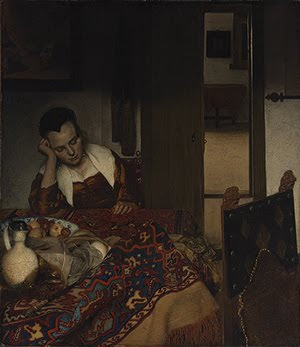
A Maid Asleep, 1656, Metropolitan Museum of Art

Officer and Laughing Girl, 1657, Frick Collection

Girl Interrupted at her Music, 1658, Frick Collection

Young Woman with a Water Pitcher, 1662, Metropolitan Museum of Art

Girl with a Lute, 1662, Metropolitan Museum of Art

Study of a Young Woman, 1665, Metropolitan Museum of Art

Mistress and Maid, 1666, Frick Collection

Allegory of the Catholic Faith, 1670, Metropolitan Museum of Art

Outside In at LaViolaBank Gallery: Walkin’ On Broken Glass

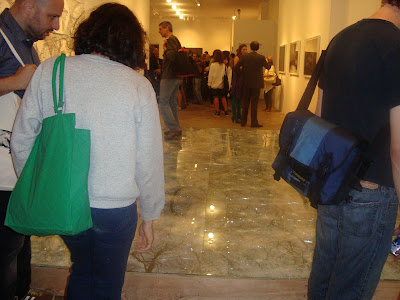
You enter Outside In, the group show at LaViolaBank gallery, by stepping up on a raised platform covered in cracked glass. People, understandably, paused hesitantly before crossing over it when I went to the opening Wednesday night. Under the chatter of the crowd, you could hear (and feel) the glass shattering beneath your feet. This makes for quite an introduction to the exhibition, which explores the personal/dreamy/unreal side of landscape. (LaViolaBank happens to be a block from my apartment, so not even lobster night could keep me away from the opening.)


Mira O’Brien’s aptly titled Glass Floor is laminated glass over photographs whose spreading geometric patterns mirror [get it, to mirror/on a mirror? no?] the cracking patterns of the glass. I enjoyed walking on the art, to see the art, while participating in the destruction of the art, in a visceral sense. The seascape beneath seemed a little insipid, like a stock nature scene. Maybe I was too distracted by the people to contemplate it. Either way, I enjoyed it overall. More on the project and her work on her website.

I also liked the charcoal drawings of Marina Berio. It probably looks like a photographic negative, which it was based on, in the jpeg below. The charcoal’s softer edges and matteness transformed the atmosphere of the piece. In a sense, these were the most literal pieces in this rather dreamy show, but by changing medium I thought they gained a greater atmospheric value. If you’re in the neighborhood before October 18, have a look.