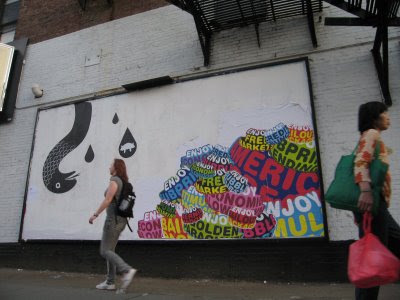
 Kenmare St. and Elizabeth St., NYC
An ambitious project took place this past weekend, and only a scattered handful of passers by took note. If you look, however, you might begin to notice it on your morning commute or across from your apartment. The
Wooster Collective, a street art blog, describes the escapade thus:
“Jordan Seiler’s incredibly ambitious New York Street Advertising Takeover became a reality yesterday [April 25], when over 120 illegal billboards throughout the city were white washed by dozens of volunteers.
NYSAT was organized as a reaction to the hundreds of billboards that are not registered with the city, and therefore are illegal. While illegal, these violations are not being prosecuted by the City of New York, allowing the billboard companies to garner huge profits by cluttering our outdoor space with intrusive and ugly ads.
After the illegal spots were white washed, late in the day yesterday over eight artists transformed these spaces into personal pieces of art.”
It’s a
guerilla beautification campaign! Artist Jordan Sieler’s
Public Ad Campaign organizes and documents artists who work against the advertising that has spread in traditionally non-commercial spaces. Now if only all New Yorkers would get so motivated and pick up litter and work in their community gardens. While it’s a cool project with beautiful results, it raises some questions.

Is that what the public wants done on their advertising space?
Sieler
states that ‘By commodifying public space, outdoor advertising has monopolized the surfaces that shape our shared space. Private property laws protect the communications made by outdoor advertising while systematically preventing public usage of that space,’ but the public isn’t deciding what to do with these artist’s buildboards, the illegal artists are.
Is there a difference between street art and advertising? Or art and advertising?
Art has literally taken the place of advertising in this case, and if anything it erases that line in the sand between the two a little bit more. Contemporary art is an inclusive practice and more street artists are crossing over to advertising (ahem, Shepard Fairy) and no end of graphic designers are also artists use a similar visual vocabulary whether they are creating art or advertising.
Why is promoting art (and one’s work) better than promoting a Coca-Cola?
Advertising serves a specific function, to sell something. Art, especially the guerrilla street art that makes up the Public Ad Campaign, often has an ideology and purpose behind it too. So is the difference really the type of thing it’s promoting, Coca-Cola or ideas? A coke might have a specific dollar value, but either way it’s propaganda.
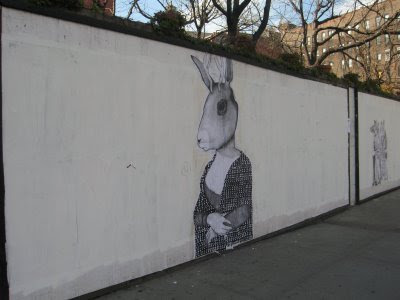
Bowery and 4th St., NYC
That being said, I like the results. I, as an individual, find the donkey’s head on the wall more interesting and beautiful than most advertising. But this campaign makes it seem like guerilla warfare is going on against the big advertisers, and the public doesn’t get a say on either side of things, despite the fact that it is obstensibly for the benefit of the public. I guess it’s like most wars in that sense.
Not like ArtPrize, where anyone who visits the fair in Grand Rapids gets to vote on the winning artwork. But that’s another story for another day.
For more billboard pictures, see here or here.