Cy Twombly and Tara Donovan: Connections

Tara Donovan’s recent exhibition at the Metropolitan Museum of Art awakened me to how lovely and natural her sprawling forms can be, making me quite pleased she won a MacArthur “genius” grant. Composed of a single type of “ready-made” material, she deconstructs the material until you see the essence of its structure and qualities in the way she presents it. She uses mylar tape on the walls of the Met, tacking the shiny rings across the walls like the natural growth of fungus or barnacles. The photograph (below) gives you no true sense of the feel of the

walls, or the gloss of the transformed mylar. Donovan both brings the material into its essence, and gives it a new identity. The way she organizes her material, as one can see here, is organic and expansive, holistic in a way that encompasses chaos. I find the subtle, minor variations of the patterns of rings trance-inducing.
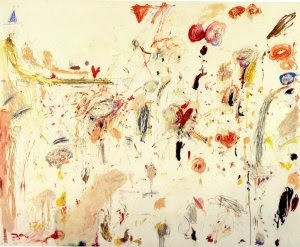

Let’s take another contemporary American artist, Cy Twombly, who I feel is more similar to Donovan than is immediately apparent. Wikipedia categorizes him as “well known for his large scale, freely-scribbled, calligraphic style graffiti paintings; on solid fields of mostly gray, tan, or off-white colors.” For both artists, scale is large. Twombly’s abstract paintings create similar designs whose internal harmony mimics that of nature.

Obviously Twombly is quite painterly and messy, and Donovan has a clean-edged, minimalist aesthetic to her sculpture. However, the works of both display a harmony through sprawling, organic balance in patterns echoing Donovan’s work above. Both artists use organic arrangements to evoke a chaotic materiality. Their works are atmospheric, rather than explicit, and scattered rather than centered. What they are saying about the world, even in Twombly’s paintings where he writes it out, is unclear, but how they say it is tantalizing.

The Difficulty of the Blank Page

Faced with a choice, one option of 2 or 3, life is easy. A blank page or an empty screen, however, is unlimited. Unconstrained, it becomes a mirror of yourself. A blank page is a scary thing: you simply stare at yourself, blinking.

Isaac Babel, in his short story Guy de Maupassant [photo of l’inspiration, right], affirms the necessity of perfection in each choice of word, claiming “No iron can pierce the heart with such force as a period put just at the right place.” Babel was a tireless reviser, editing and reediting his work, making each survivor almost a miracle. I admire this style, and between it and my affirmed fear of seeing what my reflection would be, very, very few words make it onto a page of mine.

This is an unsatisfying result; one must have courage. I shall try to write this blog more in the manner of Fernando Pessoa’s Book of Disquiet. Aside from it miserable navel-gazing, I hope for my fragments to achieve a continuity as his do, over time, repetively. So a minimum of editing to each of these posts! I want conclusions to be drawn out of a spiderweb pattern, and atmosphere to glisten like dew from each strand. Perhaps one day I’ll stare long and hard at my own reflection.

The Remains of the Day

I remember the acting being top-notch in the film version of Ishiguro’s The Remains of the Day. So seeing it on the bookstore shelves, I thought it would be a nice story to settle down with one night, especially as I’ve a fondness for the pre-war British era. I agree with the promo copy on the back, “The novel rests firmly on the narrative sophistication and flawless control of tone…” A butler is the narrating protagonist with no personal life, and it is through Ishiguro’s excellent manipulation of diction and memory that through the butler’s words we gain a more complete picture of the man Stevens than he has of himself. Stevens is more butler than human, consistently rejecting any attempts at familiarity and placing all is efforts toward his profession. Naturally this leaves him alone at the end of his life, and the novel closes with his sitting on a pier at the end of a rare vacation at the end of the day. He has doubts about the integrity of the man he served, so that he is even denied the comfort of a knowing he contributed to the world. True to form, with a stiff upper lip, Stevens decides to work harder at bantering with his new American employer—both quite foreign to him—and the novel closes on neither a dismal or hopeful note. Rather, it affirms that life goes on, and one goes on with it as one ages and times change. Life is still life, and for all the flaws a character has or the “might have beens,” the life one has is the most precious one to try to live.
This being said, and excellent movie notwithstanding, this was not an inspired or great book. It was competently written with great attention to structure, tone and resolution. However, it felt predictable. I found Steven’s tone more wearing in its digressions than interesting. Perhaps it is merely a simple story of a stodgy butler past his prime, and not much more can be done with it. Perhaps his character, even as you watch it turn away from what it most wants without realizing it, lacks appeal. All he really seems to lack is the ability to change—is that what makes characters interesting? Perhaps the best way to explain is this: the book is exactly like its protagonist. That is a great compliment to the telling of it, while explaining its limitations are those of narrowness, singular viewpoint, and inflexibility. Fortunately for the novel, the tragedy of being left behind by the world was not a fate it shared.