Part one of ten, more here.
Originally from lines and colors.
Monthly Archives: June 2011
Richard Serra Drawing at the Met
 |
| The artist in his exhibition |
My expectations were not high for the Richard Serra Drawing: A Retrospective exhibition at the Metropolitan Museum of Art. His monumental, simple sculptures hardly seemed likely to be very impressive in sketch form. But as the artist has mentioned in interviews, this body of work is separate from his sculpture–and his black or two-toned large drawings interact with the space and the viewer in some of the same ways his sculptures do and maintain the impressive scale one is used to in his work. For clarification, see above: those black walls enclosing the artist are the drawing.
 |
| Institutionalized Abstract Art, 1976 |
Altogether, walking through the galleries was a zen experience, and not just because the crowds from the Alexander McQueen show hadn’t stumbled in. The large shapes and neutral palate (more on his use of black below) gave focus to the experience of walking through the exhibition, and noticing how the works interacted with the space, and my space.

From an interview with the artist on Artinfo.com:


Serra’s comment on black having weight seems very true in this show. The works pictured here are mostly from the mid-1970s, when Serra started using black paintstick, a mixture of pigment, oil, and wax. He has continued to use paintstick to make thick black textured surfaces from the first ‘Installation Drawings,’ monumental works on canvas or linen pinned directly to the wall and thickly covered with black paintstick, to the work he created specifically for the Met’s exhibition in 2011.

Still Life & Motion at DCKT Contemporary
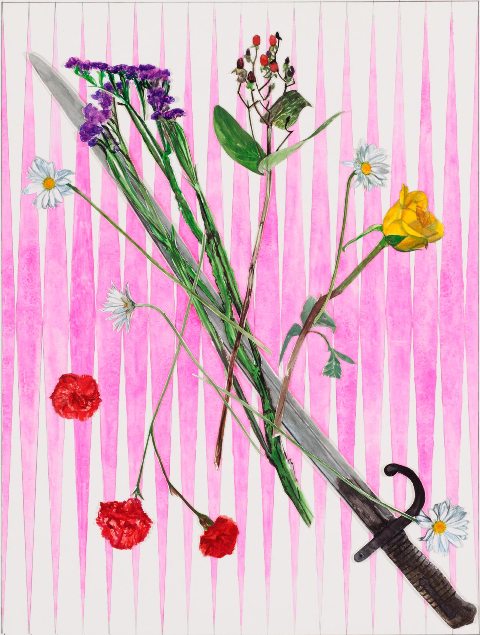 |
| Bouquet, Everest Hall, 2011 |
Still Life and Motion: Everest Hall and Sean Capone opened Thursday night on the LES DCKT Contemporary gallery, and alltogether made for a nice, small show that speaks to a very contemporary way of handling the age-old still life genre. Everest Hall provides the still lifes of the exhibition’s title, with roses on rather geometric backgrounds that seem paper-thin, fragile, and false. Sean Capone provides the motion, showing roses and other flowers exploding and fading out like a kaleidoscope setting for a flat screen. The works complimented each other nicely, but Hall’s work seemed the weaker part of the show.
 |
| Still from Sub Rosa (What We Do Is Secret), Sean Capone, 2009 |
Capone’s two video installations were fascinated to watch as they played on an endless loop. I was also very intrigued by the sales premise behind them. Literally a few minutes after complaining to a friend about how I can’t afford any of the artwork I see, I looked at the price list and saw the videos being sold as a file on a USB drive for $125, and that they artist had limited the editions to 100. The artist created his own principle of scarcity that was really interesting, and I could certainly dig projecting those patterns onto my living room wall 24/7. I was also really impressed and interested by the site-specific installations he had created in the past. In fact, they are amazing: see here.
 |
| FloralWall (Skull & Void #3), Sean Capone, 2010 |