Scandal to Debate: National Poetry Scene

If you’re British, you’ve been inundated by news of the Oxford Professor of Poetry. If you’re American, you probably just yawned at the words. Perhaps if I had written the Professor of Poetry sex scandal you would have pricked up your ears (although after the Clinton scandal we might have become blase about lesser sex scandals). But poetry in Britain is a scandalous, lecherous business of machinations and ambition taken seriously by a surprising number of people.

What happened is this: Oxford University nominated esteemed poet Derek Walcott as Professor of Poetry, a largely honorary position with light lecture duties. Then allegations of sexual misconduct toward female students from 20+ years prior came to light (most notably in a book titled The Lecherous Professor). Anonymous letters about the allegation were sent to 100 Oxford faculty who would be voting on the professorship in a smear campaign. Amidst the scandal, Walcott stepped down from the candidacy. Whether these past allegations should have prevented Walcott from taking the position has become a contentious issue.

The saga continues: another candidate, Ruth Padel, was selected. A few days ago news broke that Padel had tipped journalists off to Walcott’s allegations of sexual misconduct via email, effectively forming a part of the smear campaign against her rival. Padel resigned May 25 before officially holding office (while denying misconduct), and Oxford University is again left in a lurch. Poetry can be a dirty business!

This dirty business hides a wonderful secret: Britain is experiencing a poetic Renaissance in the public consciousness. In measurable news inches (just look at the culture section of the Guardian or the Times), British people are talking about poetry in their country more than ever. Aside from scandalous poets, a fuss has also been made over their new poet laureate Carol Ann Duffy, first woman and lesbian, the BBC is showing a series of programs examining poetry, and six new hardback editions of 20th century poetry have come out as part of an affordable line from Faber. Poetry is getting attention on a national level, and, if you look at comment boards, you’ll see that people honestly care about who holds the Oxford position, other candidates, and kind of role it should be.

It might be a scandal, but one that fell on receptive ears. I doubt American poets are so much more virtuous. Where are America’s poetry scandals and news inches and television programs? Why aren’t we talking about poetry?

Originally published in Blogcritics Magazine.

Bamboozling Forger Defends his Non-Nazi(?) Honor

…by proving his forgeries were in fact his.

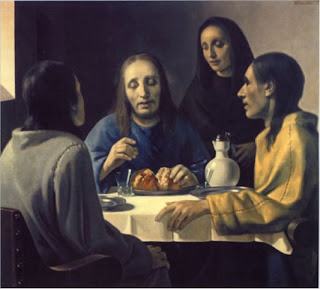
The story of Van Meegeren’s Vermeer forgeries is legendary. The New York Times has a series of in depth articles about his life, the forgeries that pulled the wool over the eyes of the biggest collector of the day, no less than Reichsmarshal Hermann Göring, and how he later had to prove that the paintings he had sold were actually forgeries to escape charges of being a Nazi collaborator (which he likely was).Van Meegeren’s story is fascinating in all its details, likes how he mixed bakelite into his paintings and baked them to give them the appearance of age or the book of sentimental drawings he made Hitler.

The articles are based on two books that came out this past year, one of which, The Forger’s Spell by Edward Dolnick, I read and would recommend. In fact, I did recommend it, and included an interesting side story to boot. Interviews with both authors were interesting, and I can’t wait for part 3 to come out.

You can also gawk at how bad some of Van Meegeren’s ‘Vermeers‘ were.


Just Kidding–the last one is a real Vermeer. And it’s actually coming to New York, as a loan to the Met for a Dutch painting exhibition in the fall.

Ravels in Review

This week will no doubt go down in your minds and blogger history as being that of my birthday. Good–please remember that next May 26.

  • As I learned in doing historical research, historically few great things have happened on May 26 aside from my birth.
  • I wrote about my experience buying art (none) and some of the difficulties of buying art on a budget. Just a note: the gallery called my boyfriend back yesterday to say that the work in particular that I had liked was available.
  • The Hernan Bas show at Lehman Maupin predicts the future to be lush and lonely, and that says a small part of how much one could say about the artist’s most recent paintings.
  • Lastly, I was so struck by an old book that accidentally came into my hands that I had to share the artist/author Eugene Fromentin’s extremely dated travel book of Dutch painters with you. He is in rapture over Rubens and Rembrandt. Hero worship like his doesn’t exist anymore in criticism, maybe to our loss.

On the other hand, Fromentin is not so kind to his contemporary (1870s) art scene in France. The Impressionists, apparently, have no sense of value or line or color, and only Corot and Delacroix are worthy of respect. In fact, let me leave you with a few more of his words;

Landscapes make every day more proselytes than progress. Those who practise it exclusively are not more skillfull in that account, but there are more painters who try it. Open air, diffused light, the real sunlight, take today in painting, and in all paintings, an importance which has never before been recognized, and which, let us say it frankly, they do not deserve.

Photographic studies as to the effects of light have changed the greater proportion of ways of seeing, feeling, and painting. At the present time, painting is never sufficiently clear, sharp, formal, and crude.

The abuse of useless roundness has driven into excess flat surface, and bodies without thickness. Modelling disappeared the very day when the means of expression seemed best, and ought to have rendered it more intelligent, so that what was progress among the Hollanders is for us a step backward; and after issuing from archaic art, under pretext of new innovation, we return thither.