Jean-Michel Basquiat at Film Forum

For once a press release was sent to me that was topical and handy. Via my inbox, this was from Gagosian yesterday:

Gagosian Gallery

Image

JEAN-MCHEL BASQUIAT: THE RADIANT CHILD
PRODUCED and DIRECTED BY TAMRA DAVIS

Wednesday, July 21 – Tuesday, August 3 • Two Weeks
Showtimes: 1:15, 3:15, 6:00, 8:00, 10:00 • Tickets available online beginnning July 14

“Tamra Davis creates a dazzling sense of the ’80s New York art scene.”
– Caryn James, Newsweek

The meteoric rise and fall of Jean-Michel Basquiat, born 1960. In the crime-ridden NYC of the 1970s, he covers the city with the graffiti tag SAMO. In 1981 he puts paint on canvas for the first time, and by 1983 he is an artist with “rock star status.” In 1985 he and Andy Warhol become close friends and painting collaborators, but they part ways and Warhol dies suddenly in 1987. Basquiat’s heroin addiction worsens, and he dies of an overdose in 1988. The artist was 25 years old at the height of his career, and today his canvases sell for more than a million dollars. With compassion and insight, Tamra Davis details the mysteries that surround this charismatic young man, an artist of enormous talent whose fortunes mirrored the rollercoaster quality of the downtown scene he seemed to embody.

USA • 2010 • 90 MINS. • ARTHOUSE FILMS

• Q & A with Director Tamra Davis after the 8:00 show on Wednesday, July 21st and Thursday July 22nd
•Q&A with Fab 5 Freddy to follow the 8:00 show on Friday, July 23rd

To purchase tickets online: Film Forum | Box Office

Just in case you’ve developed a similar fascination with the odd cast of characters I wrote about yesterday.

Collaborators: Andy Warhol, Basquiat, and Clemente

Andy Warhol: The Last Decade is full of surprises for those who aren’t familiar with Andy’s later career, and while the work is far from consistently great, it does pack a few gens in and quite a few interesting moments (i.e. 80s music videos produced by and including cameos of Warhol).  The exhibition at the Brooklyn Museum of Art is the first U.S. museum survey to examine Warhol’s later work, a period marked by prolific experimentation.

In October 1982, the Swiss art dealer Bruno Bischofberger introduced Warhol to a young painter of the Neo-Expressionist movement, Jean-Michel Basquiat. The two developed a close relationship that lasted nearly three years. The collaborated on paintings in the studio in the afternoon and went clubbing at night.

Relaxing the extraordinary potential of their collaboration, Bischoberger commissioned a series of works by Warhol, Basquiat and the Italian painter Francesco Clemente. The artists would send the canvas to each other’s studio and work on it in turn. In Origin of Cotton, above, you can see Warhol’s yellow flower, Clemente’s painterly heads, and Basquiat’s white screen printed lines and words. It’s not my favorite work from any of the artist’s oeuvres, but it is fascinating to think of these great artists from different generations and styles working together on pieces.

Contemporary Tibetan Artists Transform Tradition

Tradition Transformed: Tibetan Artists Respond makes a strong case for the awesomeness of the Ruben Museum and the vibrancy of Himalayan art. Nine contemporary artists from Tibet created works who handle the Tibetan art traditions passed down to them with a knowledge, use, and comment on the West. The differences between the Western world where these artists practice and their Tibetan roots is a major theme, as one can see in one of Gonkar Gyatso’s self portraits above. All the artists showed some very strong work, both in its own right and in conjunction with the rest of the Rubin museum, which provides such a great background on the tradition that these artists have inherited.

Losang Gyatso has some beautiful work up, including my favorite, above. His latest digitally manipulated prints glow with bright, unfocused colors. This image was inspired by a traditional piece in the permanent collection.

Tsherin Sherpa, Untitled, 2010

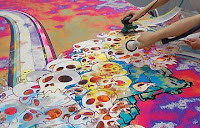
Sherpa’s work, above, reminded me strongly of the recent Takashi Murakami exhibition at Gagosian. Murakami also includes a plethora of brightly colored skulls in this large scale painting that references Japanese Bhuddist tradition (detail left). It is not uncommon to see dancing and smiling
skulls in traditional Tibetan Bhuddist art, although perhaps not in neon hues. While in Sherpa’s work, each tiny skull is painted, Gonkar Gyatsu often uses skull stickers and others materials to create images based on traditional presentations of the Bhudda.

If you haven’t made it to the Rubin Museum yet, try to check it out while Tradition Transformed is still on view–through October 18.