The Writing on the Wall: Tangled Alphabets and Words

Leon Ferrari, left, and Mira Schendel, right

If a picture is worth a thousand words, a picture containing words has worth to the nth power. The special exhibition up at MoMA now, Tangled Alphabets, examines the works of two artists who explore words extensively in their works, and it got me thinking about how words have been used in art. Writing on an artwork exists traditionally as a signature or a date, or perhaps an inscription such as ‘Marcus me fecit.’

Tangled Alphabets focuses on the work of South American painters León Ferrari and Mira Schendel. The show says that the artists “produced their works in the neighboring countries of Argentina and Brazil throughout the 1960s and 1980s, when the question of language was particularly central to Western culture due to the central role taken by post-structuralism, semiotics, and the philosophy of language.

Franz Kline, left, and Cy Twombly, right.

Since the 1950s however, writing has come into prominence in the visual arts. Surrealism, and the automatic writing it inspired (where the author writes from his or her unconscious) combined with an interest in the East, led to the prominence of the written word in Abstract Expressionist works. And, at least according to the critic Harold Rosenberg, the action painting popular at the time allowed the psyche assert or express itself, similar to the process of automatic writing.

From Wikipedia we have it that “automatic writing was an important vehicle for action painters Franz Kline in his black and white paintings, Jackson Pollock, Mark Tobey and Cy Twombly who used gesture, surface, and line to create calligraphic, linear symbols and skeins that resemble language, and resonate as powerful manifestations from the collective unconscious.” In the hands of artists like Kline or Twombly, writing becomes a lush visual element. (Kline denied that it was in fact calligraphy; Twombly’s graffiti-like scrawls are legible.)

Andy Warhol, left, and Roy Lichtenstein, right.

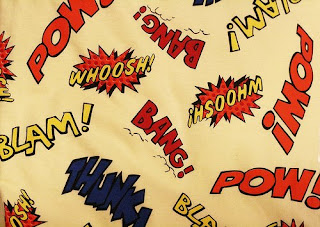
Of course, pop art took words in another direction, as they exploited comic books (Roy Lichtenstein) or packaging (Warhol) In these works, the words are an intrinsic part of the image being reappropriated. In the reuse of printed materials, like some of Robert Raucheneberg’s collages, words become part of the material itself.

For a contemporary approach to automatic writing, look no further than MoMA’s recent acquisition. This untitled work, above, by British artist Jack Strange features a lead ball pressing down the g key indefinitely. (I was born the same year as the artist, 1984, and feel like I desperately need to catch up with someone who already has 2 works at MoMA!)

Words are conceptual and tied to a specific meaning, while the visual arts are just that, visual, visceral and more fluid in meaning. The combination of words and images makes your mind work overtime. Having to read something uses a different part of the brain that looking at something, and sometimes words seem too explicit. On the other hand, they certainly pack a punch.
On sale this Spring for what?

Let’s play a game, shall we? The New York Times highlighted some quality works coming up for auction that have a newly-lowered price tag. I thought we’d play a little game to see how our own values line up with art world estimates.

Here’s the game: match the artwork with its estimate.

The Prices, in no particular order:
1. 1.2 to 1.8 M; 2. 3.5 to 4.5 M; 3. 16 to 24 M; 4. 1.2 to 1.8 M; 5. 6 to 8 M; 6. 6 to 8 M

The Artworks:

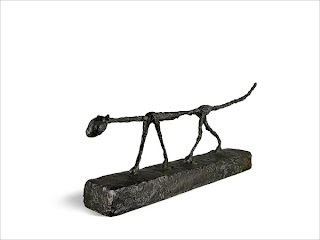
A. Giacommetti’s The Cat

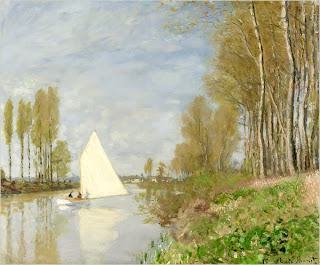
B. Monet’s Sailboat on the River Seine, Argenteuil

C. Martin Kippenberger’s Untitled Self-Portrait

D. Jeff Koon’s Baroque Egg With Bow (Turquoise/Magenta)

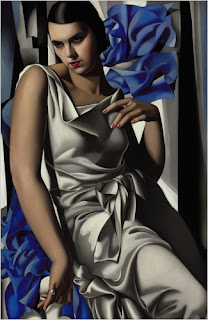
E. Tamara de Lempicka’s Portrait of Madame M.

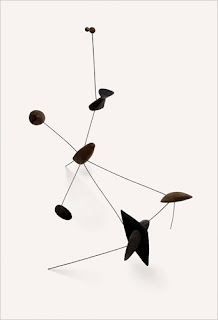
F. Alexander Calder’s Untitled Wall Relief

The answers are listed below. Auction houses consider Impressionist and Modern works to be the most stable purchases. These choices certainly cover many tastes. Does a Monet now cost more than a Jeff Koons? Are any of these estimates more than guesses (16 to 24M is a wide range…)?

These sales begin today at the big auction houses, so if you have disposable income in the range of 1M plus, maybe you should check out these newly-minted bargains. For the rest of us, I’ve got my thinking cap on for how we might get a little art on the walls. Cheers!

Answers: 1 & 4 at 1.2 to 1.8M are B and F, 2 at 3.5 to 4.5M is C, 3 at 16 to 24M is A, 5 & 6 at 6 to 8M are D and E.

*See the addendum for auction results. (May 7)

South Pacific at Lincoln Center

Nellie Forbush singing HoneyBun

I know you’ll be happy to hear that the parents’ trip to New York was capped yesterday afternoon by South Pacific, the musical revival on at Lincoln Center. I had seen parts of the movie before, and was looking forward to it. My dad, on the other hand, apparently has been idolizing the musical ever since his parents went up to New York to see the original production and left him behind. The music, the actors, the stage; he was in heaven.

Granted, South Pacific is a Rogers and Hammerstein classic from 1949 and generally considered one of the greatest musicals. The story is set in the South Pacific around a naval base during WWII, and the stories of nurse Nelly and Lieutenant Joe falling in love with people from the island inspire some classic Broadway songs, like Some Enchanted Evening and Happy Talk.

Lincoln Center’s production is the first time it has been back to Broadway and yet, judging from the audience, it might have been the second time many of them have seen it. It hasn’t changed much (from the movie version at least) and the production is flawless.

The musical itself has aged well: rather than being dated, it is charmingly vintage. The cast has been well-chosen for their parts, and the music of Rogers and Hammerstein is still a joy to hear. If you want to revisit some classic Broadway, this traditional and well-executed revival is a pleasant way to do it.