Louise Fishman’s Accomplished Abstractions

If a mark of success is survival, then Louise Fishman, at 70, is in prime form to make her mark in the annals of American abstraction as well as on canvas. Her show at Cheim and Reed, on through May 2, is a great chance to see the accomplished paintings of an artist who has matured over a long career.

As the press release for the exhibition states, “Now seventy years old, Fishman is from a generation of artists that includes Brice Marden (age 70), Mary Heilmann (age 68), Robert Mangold (age 71), Lynda Benglis (age 67), Bill Jensen (age 63), Pat Steir (age 68) and Robert Ryman (age 78).” All of whom just missed the beginnings of Abstract Expressionism and form a second generation who took abstraction different ways.


It’s old hat, if still well-warranted, to point out that Abstract Expressionism’s started out as a boys club that excluded some able female painters who were very much a part of the 1940s American art scene. Talented women were part of the Abstract Expressionism during its first years, but their careers differ from that of their male counterparts. Exemplia gratis: Elaine de Kooning. However, to understand Fishman’s current paintings as important because she is a female who does abstract paintings would take credit from the work itself and ignores the story of how she came to the gestural abstraction she is known for now.

Fishman was not always an abstract painter. An active feminist, her works in the 60s (grid paintings) and early 70s (traditional women’s work, like knitting) eventually led her to embrace a style of painting that was traditionally ‘masculine.’

Fishman’s style of painting is noted for its energy and textures, a process of mark making and layering that creates a densely-worked canvas. The paintings in this show are large and physical. These abstract canvases create a layered world that suggests something lurking underneath. I thought the show a Cheim and Reed was impressive and well-worth a visit.

ArtPrize: A ‘Radically Open’ Taste Test

If you didn’t follow the link to ArtPrize at the end of my post yesterday, don’t worry. Because if high-handed art-ad warfare deserves a post, so does a ‘radically-open’ art competition with the biggest prize in the world ($25,000 for first place) whose fate will be decided this coming October 1.

I’ve mentioned before how American taste and critical opinion can go separate ways (for example, see post on Andrew Wyeth and Norman Rockwell)–I can’t wait to see if that proves to be the case with Artprize.

Will some hot shot of the Whitney Biennial, an art fair that “characterizes the state of American art today,” win? Or perhaps an older, half-forgotten artist? Will it be a traditional oil painting, or a minamalist poly-resin casting containing nothingness? I feel like this is a litmus test for what America considers beautiful. What will it say about American’s ideas of beauty? When I consider the opinions of the various people I know, I’m really not sure how to answer that question. (The New York Times mockingly called it ‘Art Idol.’ )

ArtPrize is as much a social experiment as an art contest. Venues are provided by volunteers and matched with entrants. Entrants are encouraged to stay for the duration of the fair to promote their work. Voting can be done only by people who visit the fair, which is being hosted in Grand Rapids, MI. (The prize is funded by a Michigan politician) Grand Rapids might seem out of the way, but that $25,000 prize speaks pretty loudly. In fact, it screams “Pay Attention To Me.”
But what will the ArtPrize and its voting methods reflect about the state of populist American taste? I think the winner could be as follows:

  1. appeals to the lowest common denominator
  2. the prettiest
  3. the best social networker
  4. the next Leonardo da Vinci, who has been hiding inside a cave in Grand Rapids
  5. a perfectly reputable, established good artist with credentials*

*That would be the most unintersting result.

Guerilla Warfare: New York Street Advertising Takeover

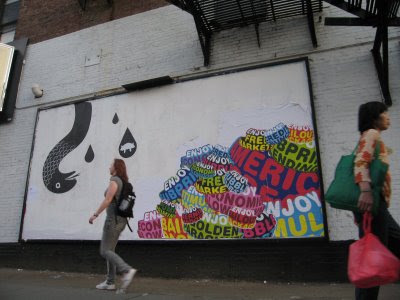
Kenmare St. and Elizabeth St., NYC

An ambitious project took place this past weekend, and only a scattered handful of passers by took note. If you look, however, you might begin to notice it on your morning commute or across from your apartment. The Wooster Collective, a street art blog, describes the escapade thus:

“Jordan Seiler’s incredibly ambitious New York Street Advertising Takeover became a reality yesterday [April 25], when over 120 illegal billboards throughout the city were white washed by dozens of volunteers.

NYSAT was organized as a reaction to the hundreds of billboards that are not registered with the city, and therefore are illegal. While illegal, these violations are not being prosecuted by the City of New York, allowing the billboard companies to garner huge profits by cluttering our outdoor space with intrusive and ugly ads.

After the illegal spots were white washed, late in the day yesterday over eight artists transformed these spaces into personal pieces of art.”

It’s a guerilla beautification campaign! Artist Jordan Sieler’s Public Ad Campaign organizes and documents artists who work against the advertising that has spread in traditionally non-commercial spaces. Now if only all New Yorkers would get so motivated and pick up litter and work in their community gardens. While it’s a cool project with beautiful results, it raises some questions.

Is that what the public wants done on their advertising space?
Sieler states that ‘By commodifying public space, outdoor advertising has monopolized the surfaces that shape our shared space. Private property laws protect the communications made by outdoor advertising while systematically preventing public usage of that space,’ but the public isn’t deciding what to do with these artist’s buildboards, the illegal artists are.
Is there a difference between street art and advertising? Or art and advertising?
Art has literally taken the place of advertising in this case, and if anything it erases that line in the sand between the two a little bit more. Contemporary art is an inclusive practice and more street artists are crossing over to advertising (ahem, Shepard Fairy) and no end of graphic designers are also artists use a similar visual vocabulary whether they are creating art or advertising.
Why is promoting art (and one’s work) better than promoting a Coca-Cola?
Advertising serves a specific function, to sell something. Art, especially the guerrilla street art that makes up the Public Ad Campaign, often has an ideology and purpose behind it too. So is the difference really the type of thing it’s promoting, Coca-Cola or ideas? A coke might have a specific dollar value, but either way it’s propaganda.

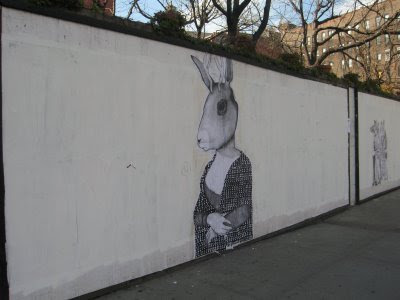
Bowery and 4th St., NYC

That being said, I like the results. I, as an individual, find the donkey’s head on the wall more interesting and beautiful than most advertising. But this campaign makes it seem like guerilla warfare is going on against the big advertisers, and the public doesn’t get a say on either side of things, despite the fact that it is obstensibly for the benefit of the public. I guess it’s like most wars in that sense.

Not like ArtPrize, where anyone who visits the fair in Grand Rapids gets to vote on the winning artwork. But that’s another story for another day.

For more billboard pictures, see here or here.