And the Pulitzer goes to…

Holland Cotter of The New York Times for Criticism.

The Pulitzer prize announced the winners yesterday and Cotter was distinguished “for his wide ranging reviews of art, from Manhattan to China, marked by acute observation, luminous writing and dramatic storytelling.” He was competing against Inga Saffron of The Philadelphia Inquirer, who I am not familiar with, and Sebastian Smee of The Boston Globe “for his fresh, accessible and energetic reviews on the New England art scene, creating for readers a sense of discovery even as he provides discerning analysis.”

I’d lean toward Smee over Cotter on mostly everything. Smee is a real joy to read, and his work has been truly “fresh” and “energetic.”

Ah well. Cotter can enter the illustrious annals of Roger Ebert for Criticism, along with Robert Frost (four times) for Poetry; Eugene O’Neill (four times) and August Wilson (twice) for Drama; and William Faulkner (twice), Norman Mailer (twice), and John Updike (twice) for Fiction.
Did you know you had to enter to win the Pulitzer? To be considered, people must go to the Pulitzer’s website and print out and submit a form along with a $50 entrance fee. Then the winner gets a cash prize of $10,000. For such a prestigious competition, it seems a little grubby.
Do you think Holland Cotter sat at his desk anxiously filling out the form last year, or do you think he has applied every year for the past 10? What about John Updike? And maybe it wasn’t fair of Robert Frost to keep nominating himself; 4 Pulitzers should be enough for anybody.
I’m assuming these individuals are motivated by the glory, rather than the money, especiallly as $10,000 is going to make or break any of them. Still, what makes you wake up one morning and think ‘Today I must apply for the Pulitzer. I am the top critic/playwright/_____ this year. Where’s that $50 check?”
What I mean to say is, perhaps a selections committee would be more dignified.

Connections: John Cage

When an unfamiliar name pops up, I may or may not pay attention, unless it happens twice in a day. John Cage was big at the Guggenheim’s The Third Mind and then at Merce Cunningham’s Nearly Ninety at BAM, where the program noted that the Merce Cunningham Dance Company was partly founded by John Cage. I started to pay attention.

John Cage, Where R = Ryoanji (3R/17), 1992

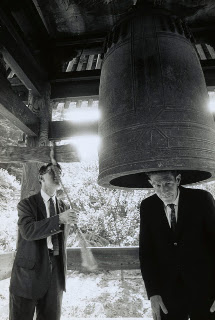
John Cage with Pianist David Tudor


Yes, the same man is connected with the circle drawings above at the Guggenheim, the photo on the left, the Fluxus movement, Merce Cunningham, and silent music. I was surprised by the collaboration of Sonic Youth and Merce Cunningham, but apparently Sonic Youth, the experimental rock band, are fans of Cage who included 3 of his pieces on their album SYR4.

John Cage (1912-1992) was primarily a composer, albeit one more fascinated by sounds in themselves than creating structure. His most (in)famous piece, 4’33, consists of three movements of silence, signaled by the pianist opening and shutting the piano. The idea behind it is to open you the the noises in the room, the rustling, the whispers, sounds from the street. Many people at the original performance did not appreciate this.

Cage is now a well-established cutural influence, whose Bhuddist-inspired work left a huge-impression on American art. As the Guggenheim describes it, “Cage staunchly refused to create art in keeping with expectations, and all his creative endeavors, including dance, music, and visual art, were revolutionary. His Lecture on Nothing began with his statement, “I am here and there is nothing to say.” His concerts were even more challenging.”

John Cage, Not Wanting to Say Anything About Marcel, 1969

John Cage’s Experimental Composition classes in the 1950s have become legendary as an American source of Fluxus, the international network of artists, composers, and designers. In addition to music, Cage created works of visual art, like the one above referring to his old chess partner Marcel Duchamp, and writings. Cage was also a life-long mushroom collector.

Merce Cunningham’s Nearly Ninety at BAM

So this is your very dance-uniformed reviewer thanking her lucky stars that she brought her camera with her last night. I wouldn’t know how to describe what I saw properly. I caught the sold-out production of Nearly Ninety arranged by legendary choreographer Merce Cunningham. Cunningham is a legend, but not one I had heard of when I bought these tickets months ago–I came for Sonic Youth.

As you can see in this short video, this was no Sonic Youth concert, but it was a interesting and exciting collaboration. I enjoyed it, but let me say that the experimental music did not strive to be harmonious and the dance was at times slow. The glittery spaceship-like set that the musicians played on and the black and white costumes were great. But check out some snippets for yourself and see what you think. And don’t hesitate to enlighten me!