Ravels in Review Friday

Raveling about art has been happening here since October. To keep you up to date, let’s review what was discussed over the past week:

  • Politics (yes, of all things…I know); I covered both international and domestic political art, with a spotlight on artists who are bucking North Korean’s propaganda bandwagon, and made a slightly enraged comment on Shepard Fairey. Suffice it to say this will be the last mention of said artist on this blog. {My conclusion is government-endorsed political art, from fascism on, is bad art. Correct me if I’m wrong.}

  • And Boxes; To illuminate you on the inner workings of the great and mysterious (and beautiful and intelligent and funny and kind) Art Ravels, I pictorially described my new living conditions.

Check these out and discuss. If you have an insatiable lust for more ravels, see the most interesting and discussed posts lately:

  • Absinthe as a Lifestyle– sometimes it’s good to be bad, and sometimes it produces / destroys artistic geniuses,


As always, read, enjoy, and let me know what you think. Ravels in Review is a new idea for a weekly Friday column, so if you love it, and more importantly if you hate it, tell me. Not that this is a democracy or anything, but I’m a benevolent dictator.

Shepard Fairey: Over Exposed and Over It

Shepard Fairey. You’ve heard the name, I’ve heard the name. We’ve seen the posters, read about the ad campaign for department store Saks. Lord knows we’ve heard about the recent Obama photograph debacle.

Look at the art. We get it. Nothing more need be said. Or even done by him. There’s a website that can do his art for you. (Note the website is pretty neat.) Never want to hear the name again, nor see another person’s internet photo Obama-ized.

Pardon me, am I ranting? If so, only because as an artist his recent work in itself is not that interesting.
&
There. I said it.

Korea Report: Art+Politics=BAD

At least, it can stir up a lot of trouble for artists who wish to comment on North Korea.

Lovely, isn’t he?

With plenty of room for irony, some artists are highlighting the difference between the smiling pomp of North Korean state cultural institutions and the hunger and isolation faced by average North Koreans. They popped up on ArtCal Zine’s radar as well as the International Herald Tribune’s yesterday, and both artist’s works center around the concept of juche.

For our purposes, juche is a state ideology that emphasizes self-sufficiency and isolation, but all the people’s happiness with the ideology. One of its stated goals is ‘molding people ideologically as communists and mobilizing them to constructive action.‘ Somehow I don’t think these artists works would count as constructive, despite their use of juche motifs.
ArtCal reccomends the film The Juche Idea, saying “[it] delves into the isolationist state’s rich history of state-sponsored and propagandist film making (in the 1970s, Kim Jong published a treatise on cinema) and comes out with what appears to be a suite of shorter films strung along a playful meta-narrative of a South Korean video artist making work on a special North Korean residency program. Unlike so many contemporary artists who show nothing but naked contempt for such difficult topics, Finn approaches his with a unique humor and wit.”
##
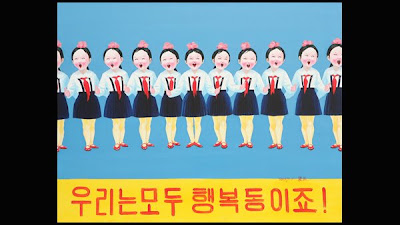
Similarly, the ‘faceless’ artist Sun Mu was highlighted in the International Herald Tribune for the paintings that he has done since escaping from North Korea. Remaining unphotographed to prevent familial reprisals in North Korea, Mu has painted juche ideals so well that he was almost arrested because in South Korea they have a law against propaganda and didn’t understand the irony intended.
65
This reads and is titled, We are all happy children!, from a popular song.
34
The use of humor to empty juche images of significance is powerful, and hopefully understood in Korea and elsewhere.