 Agatha Christie’s murder mysteries is to crime what Romeo and Juliet is to lovers; her thrillers inspires admiration from criminals themselves. My ignorant companion of last night made some distinctly unappreciative sounds when he discovered what my ‘big find’ at the library yesterday was. Harrumph! was my returning noise, and so we watched The Blue Train, A&E version of the novel starring David Suchet. Soon he was chuckling at the detective Poirot’s vanity over his waxed moustache and throwing out (entirely wrong) guesses as to whodunit. The perennial popularity of Agatha Christie, the best-selling author of all time at over 2 billion books, stem from the ‘order and method’ she uses to construct her thrillers, the same ‘order and method of the little grey cells’ with which Poirot solves his cases.
Order and Method
Agatha Christie’s work is brilliant because its purely driven by plot. A whodunit is a suspenseful process of revealing facts, and with Poirot’s ‘order and method’ arranging them into a solution. The order and method of my little grey cells, as opposed to Poirot’s, are perhaps not so strong. In Christie’s work, nothing in the plot is superfluous to arriving at this denouement. Characters gradually expose themselves in connection to it, people knew each other through it, and closed situations such as the snowed-in manor house or blue train have the advantage of keeping the suspect pool focused but large.
This is not to say I disparage her characters because they are by-products of plot. She sketches individuality in a few quick strokes. Overall, her books capture post-WWII British society with the wounds of the past and the changing mores of the Jazz Age. But her characters are plausible without the reader being tempted into their interior lives. They are shallow books of circumstance and mere fun, but mere fun is a great thing and Christie writes them to perfection.
Christie quite rightly tends to keep the viewpoint to a limited 3rd person, so that we see what Poirot sees, but not what he thinks. This engages the reader to sleuth out the mystery too. The few novels that she has done from the point of view of a character has its pitfalls, as the reader automatically side with the protagonist. It feels like a gyp when something happens that the narrator leaves out.
Of course she’s popular: her whodunits perfect their type, and her detectives are delicious, whether it be the wax-moustached Belgian Hercule Poirot or the old village gossip Miss Marple.
But who is this woman? 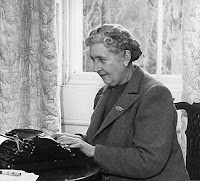
The Queen of Crime was in many senses a steadfast, disciplined writer who produced mystery upon mystery rather than illegal activities. She remains something of an enigma herself. While the later part of her life found her happily married to an archaeologist- not Mr. Christie- and going on digs between buying new houses, there was a most curious case (more here) in her youth. The only odd incident in an interesting, but ordinary life.
She disappeared in 1926. Classically enough, without a trace. The police were at their wits end for 11 days. Then one day a reporter is in a hotel lobby in the country. He notices something odd about the woman sitting on the chair. “Mrs. Christie?” he asks. Mrs. Christie blinks, and says “Oh yes. I have no idea how I got here.” To the end of her life she claimed amnesia.

