Hating Philip Roth’s The Dying Animal and Sabbath’s Theater

Maybe you learn more about yourself by reading a book. Apparently I find lecherous, scheming old men inexcusable, and therefore renounce Philip Roth’s works. I finished The Dying Animal, about an aging professor having an affair with a young woman that drives him mad, over a year ago. I didn’t enjoy this accomplished, character-driven story last year, for all its merit. I was never going to read him again. Currently, I am not enjoying Sabbath’s Theater, which seems remarkably similar.

Indeed, I hate Sabbath’s Theater much as I hated The Dying Animal. In Roth’s hands, themes of sexuality rankle with me. Adultery is glorified as the only real type of love, where both partners are free. (Except it never really works out well for the aging buccaneer.) His emphasis on sexuality seems wishful rather than a fully formed theory about people. As is imagined sex with young girls and prostitutes and maids were some Freudian projection of his penis, and thus his self-worth. Yet he buys into conventional morality just enough to use its labels of ‘bad girl’ and ‘satanic lust’ to great effect. Interestingly, sex ultimately does not offer his characters salvation. Maybe conflating Roth and his characters is a mistake?
I do not identify with, and in fact hate, the protagonist of Sabbath’s Theater, which is a problem in a character-driven novel. Hate is no light word, and I think for Roth to inspire such a reactions in me he must be doing something right. Sabbath’s Theater is driven by the death of a great mistress and realization that Sabbath has nothing left. Sabbath, a puppeteer before he became an arthritic, lecherous old man, attempts to deal with this much like a mental patient.
Sabbath’s (and Roth’s for all I can see) merit is a brutal honesty and fluency when describing life without money or friends or hope, when all the women you love have died, and the feeble desires of a fading penis become more than solace but life itself. Despite what you might think, Sabbath needs no pity from you, dear Reader, and Roth accomplished something when he created a character so repulsive that even hearing of his brother’s death and mother’s tragedy doesn’t redeem him somewhat. Theories on the glories of free love, love you pay for, and love with those underage fall much like self-justifications on these deaf ears.

As to recommending these books, rarely have I enjoyed reading something so little. Yet both The Dying Animal and Sabbath’s Theater are capably done. The characters are rich and interesting, and the harsh, jaded take on humanity is as humorous as it is dour. Philip Roth is an accomplished writer with a great knowledge of the nuances of people; I just happen to dislike his people. Hating his novels makes me wonder if there’s something wrong with me….
New York City Art Museums on the Cheap

I can claim expertise in few things, but how to view art on the cheap is something at which I excel. With the right timing and a flexible schedule, you don’t need to pay oodles to see the museums of New York City.

Below are the how-tos to seeing some of the greatest works of art in the world. Whatever your taste, these eight New York City museums are easy and fun to visit on the cheap. Note that listed prices are for adults; admission for students, seniors, and children often has a discounted price.

First, let’s hit the “majors,” which should be part of any cultural enthusiast’s outings in New York City.

1. The Metropolitan Museum of Art (1000 Fifth Avenue)
The Met lists a suggested ticket price of $20 dollars. A suggestion is not a price. They accept as little as a dollar, and then you’re in to see this behemoth’s grand cultural offerings, ranging from Egyptian pyramids to African reed boats to European portraits. They also have constantly changing exhibitions, which are included with the price of admission.

2. The Museum of Modern Art (11 West 53 Street)
MoMA will cost you $20 as well, unless you go on Friday nights. On Fridays between 4 pm and 8 pm, Target hosts a free night at the preeminent museum of modern and contemporary art. An additional great secret: movie tickets are free with admission. I’ve picked up tickets for an 8:30 film, and seen everything from John Waters’ Pink Flamingos to classics of German avant-garde cinema. Beware the crowds, however.

3. Solomon R. Guggenheim Museum (1071 Fifth Avenue)
Is seeing the interior of the newly-restored Frank Lloyd Wright building worth $18? The Guggenheim certainly has great exhibitions of contemporary art right now. However, this private museum is not cheapskate-friendly. If you’re going to pay, you should check their events calendar to make sure you time your trip to coincide with one of their lectures or, even better, go to their Art after Dark program where they have DJs until 1 am.

These big stars are definitely worth a visit, but the city has other outstanding art museums that are well worth your time.

4. Whitney Museum of American Art (945 Madison Avenue)
Fifteen dollars will give you access to the Whitney’s collection of 20th century American art and exhibitions of American artists past and present, such as Kara Walker and William Eggleston. Like so many on this list, the Whitney also has a Friday night pay-what-you-wish program from 6 to 9 pm. The Whitney goes a step beyond the other museums by making the free night a fun event with live music and other innovative performance arts.

5. The Frick Collection (1 E. 70th St.)
Admittedly a narrow time slot, but from 11 am to 1 pm on Sundays, you can visit the Frick for free instead of for $15. Often overlooked compared to bigger museums, this little jewel of a collection has remained in the mansion of turn-of the century business tycoon Henry Frick since he bequeathed it to the public. It contains masterpieces of Western painting and sculpture.

6. New Musuem (235 Bowery)
The New Museum houses contemporary art in a brand new building downtown, making it a great stop if you’re in the area. At $12, this is a relatively cheap dose of contemporary culture. However, if you’re in the the area on a Thursday night, stop in between 7 and 10 pm to mingle with a young, hipster crowd and see the works of artists artists such as Elizabeth Peyton and Mary Hielman.

7. Brooklyn Museum of Art (200 Eastern Parkway)
This museum has a diverse collection and is easily accessible from Manhattan. The suggested donation price is $8. As I mentioned in regard to the Met, a suggestion means you can pay what you wish. In addition, on the first Saturday of the month, BMA hosts a free night of art and entertainment, which often includes dancing to live music in its atrium. It exhibits art from across the globe, and has an excellent center of feminist art that features Judith Chicago’s Dinner Party.

8. American Folk Art Museum (45 West 53rd Street)
Admission is a reasonable $9 to see this under-visited museum’s collection of paintings and textiles from America’s earliest days to the present. However, if you visit on Friday evenings between 5:30 and 7:30 pm you can listen to live music in the atrium and explore the galleries for free.

If you want your culture fix cheap, New York City offers many options at its museums. In addition, galleries have openings throughout the year, where new works of an artists are shown on an intimate scale. These free openings are fun not only because you can see new works, but because of free drinks and great people-watching. Artcards is a great site to check for new openings and events. With a little forethought, you can see all the art you want on a reasonable budget.

(Originally published December 07, 2008 in Blogcritics Magazine)

When art functions as entertainment…

Can visual art such as a painting function as pure entertainment and still be art? My boyfriend argues yes.

I’m reading Sabbath’s Theater by Philip Roth, because said boyfriend left one of many copies at my house and I was destitute for a story. I’m withholding judgment on the tale of those lusty old adulterers for the moment.

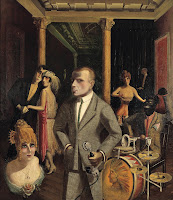
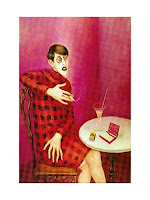
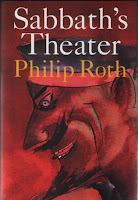
Said boyfriend bought his third (fourth?) copy of Sabbath’s Theater because the cover of appealed to him; a sailor leering over a women on a red background. It’s a reproduction of German painter Otto Dix‘s Girl with Sailor. (Unfortunately, the image is not on the internet.) The cover shows the sailor’s face on the front, and where his hand is reaching over a pale woman on the back.

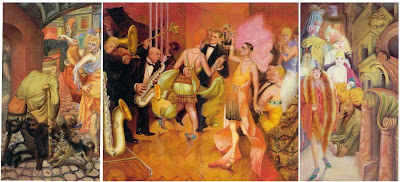
We googled Dix’s other works, which I’ve never cared for and my boyfriend found quite “fun.” Many of his paintings share the same lurid quality. Especially his art deco-ish scenes, I find a flat amalgamation of colors without harmony or meaning. His darker and more straight forward critiques of Wiemar lack subtlety and imagination. We both agree it’s poster art, mere decoration. But am I right to put in that “mere”? Why shouldn’t art be decoration?

Artists’ works are described as important, as agents of social change. That is, I’ve yet to walk into a gallery and been told that it held random bits of pretty fluff with which to decorate.

Art is a loaded term, so, despite my genius and discerning taste on so many levels, I won’t attempt to define art here. But I’m intereseted in what you think. What do you want out of art? Casual amusement, to be moved, to be entertained, to think differently because of it? Have I elevated art to unrealistic ideals by expecting more than decoration out of it?

Poster art only?