 In anticipation of tonight’s opera at the Met, I am going to tell you a secret about me: I am in love with a dead gay man. It’s true; Oscar Wilde has been the man in my life long before I had a man. He wrote a biblical tragedy of all things, this decadent fop. Then Strauss turned his Salome into an opera, and that is what I am going to see tonight.
1) A Play by Oscar Wilde
Oscar Wilde wrote Salome in 1891 in French, and an English translation came out in 1894. (Translated by Wilde, not his no good lover Bosie despite the fact the Wilde still gave him credit in the Dedication.) The play tells in one act the Biblical story of Salome, stepdaughter of Herod, who, to her stepfather’s dismay but to the delight of her mother Herodias, requests the head of Jokanaan (John the Baptist) on a silver platter as a reward for dancing the Dance of the Seven Veils. Rehearsals for the play’s debut in London began, only to be banned. The play eventually premiered in Paris in 1896, but by then Wilde was in prison.
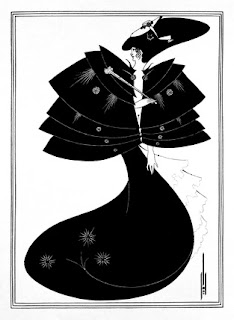
2) Illustrations by Aubrey Beardsley


 An outrageously talented artist, Aubrey Beardsely had already been greatly influential prior to his death at age 26. In 1891, at age 18, he met Wilde, who was in the process of writing Salome. Wilde asked Beardsley to illustrate the English version. He was a prefect choice for both the play and for Wilde.
Beardsley “developed a perverse and playfully theatrical style partly inspired by Greek vase painting. The venomous elegance of his drawings has an ornamental rhythm akin to the abstract decorations of Islamic palaces. For Salome, Beardsley ironically appropriated the decadent theme of the evil, emasculating woman.” (From Michael Gibson, Symbolism)
Wilde, on Beardsley’s muse: as having “moods of terrible laughter”
3) An Opera by Strauss
Those in the know (and I am not referring to myself), argue that Strauss’s Salome is the first “modern” opera and his first major operatic success. Richard Strauss composed it in 1904, and wrote the libretto as well, in German. The opera’s music is supposed to be gripping–-relating the themes of perversion, evil, and cruelty.
In Production:
The New York Times had a favorable review of the Met’s production and especially of the singer in the role of Salome. The closer it is to Wilde’s original version, and to Beardsley’s striking vision, the happier I will be.
My esteemed father would like to add that, in his opinion, nobody over 50 years of age or 250 pounds should attempt the Dance of the Seven Veils.

