Factious Fiction: Alan Bennet’s The Uncommon Reader

Perhaps you know the term ‘factious’? No? A blank slate are we? Then memorize the second italized definition, for that is the one that will be useful in this book review.

fac·tious (fak′s̸həs): adjective. 1. producing or tending to
produce faction; causing dissension 2. adding facts to fictious
stories or things, characterized by the misplacement of
fact

Alan Bennet’s new novella, The Uncommon Reader, is a light read about a dutiful Queen, a most pratical and attentive Queen, who takes to reading, of all things. Her servants put it down to dottiness, as at a ripe old age she begins thinking, noticing people, and reconsidering her duties and life.

The term factious is handy here, because Alan Bennet seems to be writing an imaginary fable about the joys of reading and self-discovery, except its about the real Queen of England with oodles of corgis and Diana’s death thrown in. A peculiar mix of fact and fiction, that is to say, factious. The dramatization of living people with stories that have nothing to do with them strikes me as a little odd, as if the Queen was a bird that wanted stuffing, if I may be so factious as to say so.

The Queen’s tone determines the whole novella, as it should since its her point-of-view, but it’s a pity her tone happens to be plain, uninsightful, and purely functional. Only at the end does the Queen take on some elegance and humor in her speech, and one gleans its a function of her reading. Novella-sized is the perfect length for its easily digestable but not inspiring tale. Amid teas and prime ministers and rain, it lacked only one British thing: that wicked sense of humor.

However, this homage to the written word did have its fun plot elements, such as the gay kitchen boy, and a neat ending, and its a pleasure to find something a little bit different on the shelves of Barnes & Noble. One also found the use of the impersonal royal tone never failed to please. Alan Bennet is a succesful author, whose most recent play is the The History Boys currently on Broadway. No doubt this little red book will find its way into many stockings come Christmas.

Celebrity Lives as Art: Mad, Bad, and Dangerous to Know

What is fame? The advantage of being known by people of whom you yourself know nothing, and for whom you care as little. Lord Byron

I would rather heap scorn on some actor-besotted rag like US Weekly than read it, and am not in the habit of sending fan mail in the hopes that some rock or soap star will come and deflower me. Even Andy Warhol, to my mind, get too much credit for being a star maker just because he churned out some movies in the Factory. If anything, Warhol began the decline of the celebrity, as he heaped attention on people with no talent or accomplishments. Fatuous, small-minded uninteresting little twerps fill the pages of the modern rag and reality TV show.

Perhaps you are wondering you could live up to my high standards of charm, uniqueness, intelligence, attractiveness and expertise. You are? Well then, allow me to present the man who started it all, the first man to have women throwing themselves at him sight unseen, the only to be talked about in London in 1816:

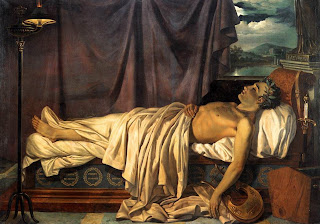
Byron, painted after his death fighting for Greek independence, crowned with laurels.

Lord Byron, famously named by a lover as “mad, bad, and dangerous to know.” His lyric poetry, combined with luscious dark curls, brought him fame at a young age. His sensual appeal appears in his work throughout his life; indeed, it becomes a part of it. Even after becoming too ‘bad’ for the London scene to tolerate, when his divorce from his wife brought up questions of sodomy and incest and his debts from his exorbitant drinking and gambling chased him to the continent.

Difficult in person, but in theory a dream of a man, he kept his readers, especially the female of the species, enthralled with his tales of dark heroes who were all reminiscent of him. In his rollicking epic Don Juan, in which he, as narrator, begins to write events of his own life into the poem, and between the bawdy lies and bawdier truth one is utterly charmed. He and his work are engrossing, whether your taste is for the Gothic, the lyric, or the romance, you’ll find a witty and sexy bad boy reflected within. Take a look at a biography, like the one by Elizabeth Longford that I’m reading now, and you find a string of romances and writings, and a poor biographer struggling to defend Byron from a thousand accusations, even now the individual fighting against the world.

Celebrity culture, created by Byron, who put his life into his writing, was furthered by Oscar Wilde, another British dandy at the opposite end of the 19th century, who declared his life was art. Wilde dressed and acted the part throughout, and slyly led respectable Victorians to the precipice of free-thinking anti-prudery. Outrageous and flamboyant as a drag queen in his velvets and green carnations, Wilde scandalized the public with his unique morality of aesthetics even as they laughed at themselves when he tore high society to shreds in the theatre. Tried ‘for posing as a Sodomite,’ Wilde could no longer not speak ‘the truth that dared not speak its name’ and the media frenzy was bigger than OJ Simpson and Britney Spears combined when he was sentenced to prison.

Depicting Wilde’s reception in America on his book tour. He started a sunflower craze.

Byron and Wilde, the patron saints of this blog, whose contributions to aesthetics are as notable for they way they lived as what they wrote. Interesting and with eventful, active lives, the talented and dangerous duo also happened to be damned good writers who brought glamour to the arts. Blame them for celebrity culture if you will, I just wish that there were more celebrities like them.

City Aesthetics: New York

My window looks onto a grey stuccoed plane rising until out of sight, punctuated by windows with air conditioning units. I can’t see the sun. The sun, when I’m on the street, if often curtained off by the buildings rising on either side of me. Grey is prominent in the city, mostly because of the grime and asphalt. Light comes down in shafts, as if even the sun had been mastered by the skyscrapers.

Apartments with exposed brick walls are cool because they have the unfinished look of factories. Lofts, the epitome of cool, are bare, industrial spaces. The Domino sugar factory, whose eponymous sign has lighted the way across the Williamsburg bridge for decades, is being transformed into luxury condos.

My colleague was showing me pictures of my street from 1910, and the view of the Manhattan bridge hasn’t changed all that much. Neither had the exteriors of the buildings, or, in the case of my building, the interior. But the gaps have all been filled in, and streets paved, highways built, and horses replaced with cabs. And people, more people, everywhere.

Divided by tall buildings, you keep your gaze on street level, where you find people and cars coming at you from all angles. You pick your way around litter. Food cart smells, advertisements and lights everywhere, and general hustles as city-dwellers attempt to get where they’re going with the least amount of fuss. A walk in midtown during rush hour is a journey. And visitors wonder why New Yorkers look mean: they have to focus. Even on quieter streets of brownstones, you know you are in a city by the honking an avenue away and the hobo on the corner.

Sometimes my sense are overwhelmed and my heart starts beating faster and I realize that I hate Manhattan.

But other times, like last night when I was biking over to the New Museum, it seemed like I was the king of the playground, and I felt empowered by the lights of the Empire State building rising ahead, and the cars at my side, and the people crossing the street. Those people and I were all the living parts of Manhattan who make our lives here. Instead of feeling acutely aware of my sense, I subsumed the city into my consciousness and become one with it.

The great thing about making your life in this complex and huge hive of activity is that there’s always a new corner to turn down, a street you’ve somehow never noticed, and the same goes for the people, so many of whom you’ll never meet, and the possible experiences, so many of which you’ll never have. But you could. Manhattan is a world of visible possibilities.

Everything you’ve always dreamed of, from glamorous dining to gorgeous apartments to some gorgeous other person, is here on the streets of Manhattan. Shop windows twinkle with more than you ever dreamed of having. Ambition and the city go hand in hand. The best of the best flock here. And then you’re here too. You look at the streets, and find a direct challenge to succeed.