Review: Catherine Opie Retrospective at the Guggenhiem

Catherine Opie’s shocking and raw portraits of herself and friends from the early 90s are what came to mind when I heard of this show on view until January 7, 2009 at the Guggenhiem New York. Her oeuvre on view at the Guggenheim not only disabused me of any notion of rawness in her work, but also opened me eyes to the extent of her subject matter. This classically American photographer came into the limelight for portraying herself and her friends as gender bending homosexuals into body modification and sadomasochism. Beyond horror or titillation, she exposed an underrepresented class of people with political intent and humanity while exploring notions of home and family.


Home and family seem stereotypically female in a way that Opie is not often considered, given her non-traditional presentations of gender. The people we see in her works are homosexual couples posed in traditional ways, of men dressed as women and vice-versa, and of tattoos and piercings that look deliberately painful. Her presentation of them staring at the camera with a direct gaze is agressive in a simple way. Yet stereotypically female too is the self-portrait of the artist holding her baby above, similar to a Madonna and Child scene, except that the luminosity and realism exposes her scarred breast where the word “Pervert” was carved for a previous portrait.


The rawness I anticipated in her work is actually a direct, at times aggressive portrayl of who people are with no apologies. She tends to present her subject–be it a person or a bridge-alone. Her portraits share the quality of formal compisition with the gaze direcly at the viewers, as well as a sense of art historical reference. For example, Opie was influnced by Hans Holbein’s use of luminous color and worldly references for a series of portraits of friends. Opie often uses ornately patterned fabrics as a background. The contrived aspect of scenes and formal aspect to portraiture lend her work a theatrical quality that is in every sense neo-Baroque.

She combines the visually gorgeous with the horrific. Two clear example are the self-portraits that involve cutting into her flesh, in which she intends to shock her message into the consciousness of America. In the first one, pictured above, she takes on what it means to be a lesbian in America in the 90s, by putting a social label on her body. The other work, showing the artist’s back cut in a childlike pattern of two figures holding hands in front of a house. The figures are two girls. This is how Opie communicates about gender and family and home–how sterio-typically domestic, no?

No, Opie is much more than that. I felt her most moving work was done of a friend and performance artist to the performance artist Ron Athey, who had recently been diagnosed with HIV. In 2000, they createded large-format Polaroids to create larger than life images of him based on past performance pieces. One strong and moving work is a lovely composition in which the precarious balance between life and death is presented as the artist lying on a bed of gold with an upraised arm from which hangs a series of neeedles. As image reproduction is severly kept in check, you would have to go to the Guggenheim to see it.

Series of highways, series of portraits, series of homes, series of couples/homes across the United States, Opie hammers home her message through repetition, as if demanding we look not at one individual, but many. The use of series really helps her explore subjects in a more illuminating and thoughtful way–otherwise easy to dismiss as a fluke. She presents a body of examples and says this is America. The importance of Opie’s work is in it’s messages about people, and, in that way, her photography is as American and compassionate as Walker Evans’ photographs during the depression were.

Portraitist Elizabeth Peyton is no Warhol (and not as fun as C.L.U.E. either)

The New Museum of Contemporary Art of Bowery is hosting Live Forever, works by portraitist Elizabeth Peyton, and so I took my excited little butt there last night, after a long day of work. (Not coincidentally, the New Museum is free on Thursdays from 7 to 10 p.m.)

I had only seen Peyton’s images online, but thought they used color well and that it was exciting to see something as traditional as figurative portraiture make a splash on the contemporary art scene. Peyton paints friends and also cultural icons in her remarkably cohesive oeuvre. As it was her paintings of Kurt Cobain, lead singer of grunge band Nirvana who committed suicide in the 90s, that brought Peyton into the limelight, I thought I would be encountering something Warhol-esque, where the confluence of the individual and pop culture become huge statements about our cultural identity.
My expectations were confounded. Peyton perhaps gives us an intimate glance into her interior world, but I wouldn’t even go so far as to say she’s making a statement about herself. And yet, she manages to say nothing about the people she portrays at the same time. Remarkable.

Peyton’s works are small and intimate, consequently seeming overwhelmed by the whiteness of the New Museum’s gallery space, and painterly in a broad way. Miniatures are often exquisitely detailed, but these approximately 10″ x 12″ works were broadly sketched out like watercolors. They were unlike traditional portraiture in that, instead of taking the subject in a formal pose, these were composed like Polaroids as if the subjects were caught unawares at extreme angles. They were well-painted and pleasant. Unfortunately, I can’t say much more in their favor.

While Peyton is a figurative portraitist, she does have a distinctive style that colonizes her subjects as her own. All her subjects become triangular faces with bright red mouths and slanty eyes, and she seems to prefer fey males. The works are stylized enough to be distinctly hers, and are more revealing of her than the subject. Perhaps that itself is the difference between her work and traditional portraiture.

Seeing her oeuvre at once, I had the idea of that this was her interior world in which the works were snapshots of memory.Peyton’s style does not seem to have evolved–any of the portraits could have been painted at any point in her career. Overall, it was a little…boring.

However, I insist you stop the New Museum anyhow, for a very small and very fun installation. Wedged into the interior staircase between the third and fourth floors, an installation called “C.L.U.E.” will entertain you better than clowns and acrobats at the big top. According to its press release, “C.L.U.E. (color location ultimate experience) is a collaboration between artists A.L. Steiner and robbinschilds (Layla Childs and Sonya Robbins), AJ Blandford, and Kinski. Like a living organism, C.L.U.E. adapts to the space it temporarily occupies. In this manifestation at the New Museum, it takes the form of site-specific performance, multichannel video installation, and video projection.”

What does that mean? It means that, once you put on the headphones, you can’t help but bob your head in time as the matching pair of girls do funny dances across parking lots, deserts and redwood forests, all via projector through the window onto the building across the way. A blast.

News Alert! Obama Cannot Save Art

Yesterday the stock market dropped 486 points, despite the fact that most of the world is excited to have a new president coming into office. The economy seems to be entering the big “R” (recession) despite all that hope and change rigmarole. Let’s relate this to the art market.

Without actually reading any of the articles below, what can we surmise from their headlines?

New York Times:
Bleak Night at Christie’s, in Both Sales and Prices

BBC:
Top art fails to sell at auction

Yesterday’s headlines from The Art Newspaper:
Auction houses embark on damage limitation exercise as market slumps
After years of growth, a long way to fall?
“Hot” categories cool rapidly as crisis bites

Anyone have an idea what this means? Any wild guesses? No…well, let’s look at this chart from The Art Newspaper’s “After Years of Growth” article, which ends in September 2008:

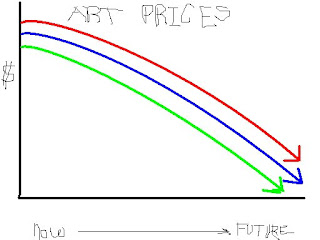
Note how the lines, representing different prices points, went way up. Now see my graph, using advanced scientific formulas and graphing software, to irrefutably predict the future:

Countless people, like your prudent parents, and articles will be telling you how to save money in the upcoming recession, stretch your dollar, etc. Well, I won’t tell you that. I’m telling you

BUY BUY BUY!

Buy what you love. Do it now if you are at all in a position to do so. Snatch up that cheap Chinese masterpiece or contemporary cutting edge foot statue you’ve been eyeing. This is your chance.

I would if I could.