Portraiture: the ignored step-sister of Contemporary Art

The Old Masters all did portraits in oils as their bread and butter, but that isn’t the case with the big names in art today. Damien Hirst is immersed in formaldehyde, and the majority of great talents are swirling in the shapes of abstraction. Who is painting portraits today? By portrait, I mean the old-fashioned, limited definition that focuses on a human subject and depicts their likeness in oils on a canvas with a degree of verisimilitude.

The real question is, does anyone do that anymore? The photograph is many way has taken over the simpler aspect of portraiture, that is, to record a person’s appearance. I was struck by the amount of portraits in the Met’s exhibition Art and Love in the Renaissance Italy, and by how few I had seen by contemporary artists. That’s not to say portraiture is a dead art, but it is hardly a genre that gets a large amount of attention.

There are a few artists of note, however:

Closest to Tradition
Elizabeth Peyton does small, intimate portraits of friends and cultural icons much as the Old Masters would have, that is, with an eye to documenting what the person looks like. She focuses on portraiture, a rarity these days. A successful and well known artist, she is the only one whose oeuvre consists mainly of portraits.


Figurative Painters of Erotic Tendencies
John Currin
is well-known for his figurative paintings, albeit of a more erotic nature. Yet he documents people less and less as stylization’s based on cartoons and old masters like Lucas Cranach, and more like individuals. For example, see this portriat of Rachel Feinstein, his wife.

Lucien Freud‘s work tends to be less camp and more fleshy, but he too is known for his figurative paintings. Here we have a self-portrait on the left. This works is a portraits in the sense that it represents him, but most of his figures are anonymous pieces of flesh. Certainly, Freud is a capable portrait artist though.

Like a photograph, but not
Chuck Close made his reputation on photorealism and figurative painting. While it’s true the style below in this self-portrait is not one Rembrandt would have used, it doesn’t comprimise the viewer’s impression of what he looks like. His very large productions that recreate the pixellated effect of prints and photographs while focusing on a realistic face.

A dying style?
Obviously this is not an exhaustive survey of contemporary art. Please tell me if I’m missing something big.

Portraiture of the old style seems to be out of style. Take a look at Art Net’s 300 most searched artists and try to find another living artist on the list who does portraits. That’s not to say there are no longer artists for hire, should you want to commission a traditional portrait. It’s just that the people on this list aren’t on the top 300 of Art Nets.
I would have argued that interest in the individual was perinneal, but perhaps I’m wrong. Has traditional portraiture become irrelevant?

Artemisia Gentileschi and her violent Judiths

Judith and Holofernes, Artemisia Gentileeschi, 1612

Judith beheading Holofernes was popular subject matter in the Baroque period. Judith, a Jewess, is sent with her attendant to the invading army camp of Holofernes, the general, who she charms and inebriates before she chops of his head, thus saving her people. Charming subject matter, no?

It is often theorized that the artist of the painting above, Artemisia Gentileschi (1593-1652) depicted the subject so forcefully because she was raped. Rape no doubt had its effect on Gentileschi, but her life is remarkable for many other reasons.

This talented woman was trained by her father Orazio in the style of Caravaggio and came to be a professional artist, a rare woman among men. She was the first woman to be a member of Academia del Designo and a painter whose historical scenes (a genre thought to be beyond women) enabled her work to be featured in the houses and churches of Florence and Venice. You can see why she is a treat for contemporary feminist theorists, both for her accomplishments and her sufferings.

Her biography is often given as a series of male-dominated events. First she was her father’s daughter. She was raped by a student of his. She was married to another painter to save her honor after the rape. After, her work is often difficult to tell from her fathers, and of her 34 extant paintings, some have only recently been attirbuted to her. Her non-feminist art historical reputation often refers to her as a Caravaggesti, one of the many followers of Caravaggio.

Yet just look at another treatment of the Judith and Holofernes below:

Judith and Holofernes, Artemisia Gentileschi, 1620

The above painting is read into as Gentileschi releasing her anger and rebelling against patriarchy by portraying a strong and vengeful female character. She was raped at 19 in 1612, and she painted the top image in 1612-3 and the one immediately above in 1620. Note how she developed her theme with a larger and more detailed treatment. The violence was not unprecedented. She was a student of Caravaggio and he too painted this subject, as it was a popular one of the period.

Judith Beheading Holofernes, Caravaggio, 1598-9

Look at Caravaggio’s portrayl, painted in 1598-9, compared to Gentileschi’s treatment of the subject. This Judith Beheading Holofernes depicts the same moment of beheading with blood spurting, but Gentileschi’s women are more active than this Judith who leans away from the blood. Caravaggio’s painting seems staid after Gentileschi’s physical treatment, despite the immense skill with which Caravaggio creates the severed head’s grimace.

Perhaps one shouldn’t view Gentileschi’s oeuvre through the lens of rape entirely, as it limits our understanding of context and the credit one can give to her accomplishments, which amount to so much more than a by-product of inflicted violence. But it can hardly help informing our perspective of her Judiths, fearlessly conquering generals. In many ways, her long and successful career can be seen as a triumph over her early rape.

Book Review: The Subway

The Subway is an intriguing quasi-fictional appropriation of reality that all New Yorkers can identify with. The Subway contains the full sweep of humanity in its passengers, as they jostle or sit at safe distances or stare into the passing faces. This panorama of society contains the myriad human interactions that make up civilization, from shoving to giving up your seat to flirting.

Minute gestures of the passengers lead one to observations of humanity. For the protagonist is like Everyman of Pilgrim’s Progress. He goes about his quest to arrive at his destination, and struggles with the conflicts of finding his metro card, missing a train by a second, being crowded into a smelly homeless person; we see his personality revealed, and as people and especially as New Yorkers, we can identify with his quest.

Within The Subway, all the glories and incongruities of American democracy are present. From the homeless to the elite, at any hour of the day the vast swell of humanity is present in all its odors. All people in the hunt for seats have the equality that makes America great.

Who wrote this fascinating study of the human psyche and deployed his acute and pointed observations on human nature? Who depicted the possible scenarios that could happen among such a group of people? No one. This novel doesn’t exist.

How is it possible that no one has written this book yet? I can’t be the only New Yorker who on their endless commute sometimes wondered about their fellow passengers, about where they were going and why. Storytelling has its roots in such unparalleled access to people. People who are too immersed in their experiences to put up facades. The subway is humanity raw and uncensored.

Considering people’s (and my own behaviors) on the subway, I’m convinced it is a minefield of character and of situation that is integral to a great story.

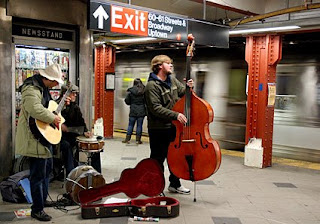
Musicians…

Mother with child, woman in pink, and Hasidic Jew

Nursing mother

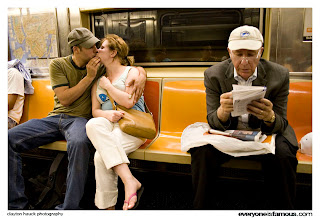
Young lovers

Homeless man

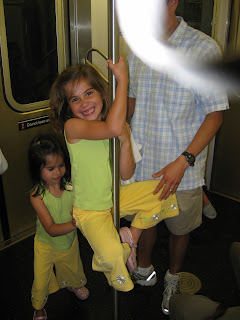
Young pole dancers

These photos from the NYC subway make great character studies. It’s seems so much like a book already written to me. But I checked on the Internet, where all things are true, and The Subway hasn’t been written. Yet.