Jealousy Strikes Over Writer’s Rooms

A creative space, exactly as you like it, and a routine, undisturbed, can make a day or, in the case of some people, a work of art. Balancing work and writing is something I’ve thought about lately, but more than that I’m curious about other people. How do they write best? So to fill that curiosity, we have creatives spaces and routines…(ahh, the wonders of the internet.)

Rooms:

The Guardian has a great page dedicated to writer’s rooms…literally a series of photographic “portraits” of the rooms the writers work in by Eamonn McCabe. Coincidentally, McCabe has an exhibit that just opened that runs through January 17 at Madison Contemporary Art if you are in London.

They’re gorgeous and interesting shots that give you an intimate look of the creative spaces of various authors. They tend to have a desk and a computer…but other than that, these spaces are as varied as can be. Some are bare spaces with merely a desk, but most tend toward a messy, comfortably chaotic appeal. I wish they would do a series of artist’s studios next.
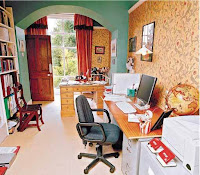
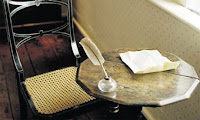
These are clearly all successful, middle-aged writers because they have rooms they can devote to writing. I live in New York city, and have a compact desk in my bedroom that I can devote to writing. There is just room for it between the door and the bed. It’s usually crowded with papers that I once meant to look at. The chair hurts my shoulders after a while. A certain someone likes to sit at it with his computer. And so, my workspace has become wherever there is a computer. A helpful versatility, no doubt, but I envy the luxury of a room of one’s own and the flourish of a quill pen, like in Jane Austen’s room, right.

Routine:

It isn’t mere space I pine for, but the lives that could be led in them. Similar to these room portraits, blog Daily Routines gives a brief summary of how artists, writers, and other ‘interesting people’ organize their day in all its intimate detail. The writer Murakami runs marathons to get into a zenlike state, much like his dreamy novels. Kafka’s is bizzare. Truman Capote is a “horizontal” author.

My routine involves a lot of ‘sometimes’. I go to an office sometime. Sometimes I have been up writing or reading for an hour. Sometimes I sleep. Sometimes I’ll polish something up during the day, sometimes I’ll write at night. Today, I’ll cook up a nice breakfast and lay in bed typing while trying to plan the most productive possible day.

I’m still settling into a quasi-writing life, but I have dreams of what it would be like. They run along the lines Oscar Wilde’s perscriptum of life as art. In which case, I have a lot of work to do. Christmas angels and huge koi decals are competing for decorative space to ill effect in this writer’s rooms. Yet based on the differences I found in rooms and routines, I’d have to say to each his own.

Art of War

Balancing work and writing has been difficult lately–Eek! Not a boring article of work and writing? Hardly, gentle Reader: this is a war.

My writing and my job are at odds with each other, and lately my job has been winning. People always speak about a work/life balance, but my problem is a work/work balance. Perhaps someday I’ll have an official writing job (perhaps you readers could mail me some checks…) but until then, I work a normal work week and try and squeeze in writing.

Time, in itself, is not the problem. I could work, and then have enough time to write a blog post on a normal workday. But the real difficulty with writing, besides saying things well, is having something to say. When I become consumed with my paying job, I loose the creative bit of my brain. I’m out of the loop on interesting news as well, and can’t process it enough to form an opinion of my own. (Opinions being crucial in this blogging business.) Of course, right now I’m talking about working and blogging, not even working and blogging and sleeping and interacting with humans… which are getting squeezed these days.

Today as I was dealing with drudgery of the day job, I stopped what I was doing and brainstormed. Slow at first, but soon I felt all juiced up and full of ideas and happier. It’s easy to forget the passions that make you happy sometimes. And then I felt inspired to write about the delicate art of balancing work and writing. I myself am not quite an artíste at this balancing act yet, but maybe someday.

Until then, Reader, I accept personal checks or cash or cookies. I am especially partial to holiday cheer in the form of sugar.

Hating Philip Roth’s The Dying Animal and Sabbath’s Theater

Maybe you learn more about yourself by reading a book. Apparently I find lecherous, scheming old men inexcusable, and therefore renounce Philip Roth’s works. I finished The Dying Animal, about an aging professor having an affair with a young woman that drives him mad, over a year ago. I didn’t enjoy this accomplished, character-driven story last year, for all its merit. I was never going to read him again. Currently, I am not enjoying Sabbath’s Theater, which seems remarkably similar.

Indeed, I hate Sabbath’s Theater much as I hated The Dying Animal. In Roth’s hands, themes of sexuality rankle with me. Adultery is glorified as the only real type of love, where both partners are free. (Except it never really works out well for the aging buccaneer.) His emphasis on sexuality seems wishful rather than a fully formed theory about people. As is imagined sex with young girls and prostitutes and maids were some Freudian projection of his penis, and thus his self-worth. Yet he buys into conventional morality just enough to use its labels of ‘bad girl’ and ‘satanic lust’ to great effect. Interestingly, sex ultimately does not offer his characters salvation. Maybe conflating Roth and his characters is a mistake?
I do not identify with, and in fact hate, the protagonist of Sabbath’s Theater, which is a problem in a character-driven novel. Hate is no light word, and I think for Roth to inspire such a reactions in me he must be doing something right. Sabbath’s Theater is driven by the death of a great mistress and realization that Sabbath has nothing left. Sabbath, a puppeteer before he became an arthritic, lecherous old man, attempts to deal with this much like a mental patient.
Sabbath’s (and Roth’s for all I can see) merit is a brutal honesty and fluency when describing life without money or friends or hope, when all the women you love have died, and the feeble desires of a fading penis become more than solace but life itself. Despite what you might think, Sabbath needs no pity from you, dear Reader, and Roth accomplished something when he created a character so repulsive that even hearing of his brother’s death and mother’s tragedy doesn’t redeem him somewhat. Theories on the glories of free love, love you pay for, and love with those underage fall much like self-justifications on these deaf ears.

As to recommending these books, rarely have I enjoyed reading something so little. Yet both The Dying Animal and Sabbath’s Theater are capably done. The characters are rich and interesting, and the harsh, jaded take on humanity is as humorous as it is dour. Philip Roth is an accomplished writer with a great knowledge of the nuances of people; I just happen to dislike his people. Hating his novels makes me wonder if there’s something wrong with me….