 Self-portrait of 1493, artist aged 22
Albrecht Durer (1471 – 1528) doesn’t get the attention those great Renaissance Italians do, Leonardo, Michelangelo, Donatello. Yet Durer did more that just woodcuts; he reinvented what was possible with woodcuts, but was also a remarkable draftsman and painter.
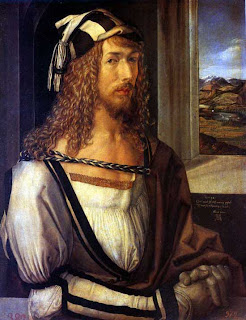 Self-Portrait of 1498
, artist aged 26
Although traditional in style, Durer brought a tirelessly innovativion to his work, and is known for merging the Italian style with the German. Born in soon-to-be Protestant Nuremburg, Durer was a humanist in the vein of Martin Luther and was one of it’s first artist-gentleman, so to speak (rather than artist-craftsman).
 Self-Portrait of 1500, artist aged 28 (and yes, he knew he looked like Jesus)
 Durer’s woodcuts were widely disseminated and successful. He also produced some very modern watercolors (at a time when other artists used crayon and paper). Durer was among the first to sign his sketches rather than consider them so much wastepaper. He also painted portraits, like the ones of himself above, but also of other individuals, large religious scenes, and some singularly beautiful works of pieces of turf and animals. More and more Durer tried to capture the secret of natural beauty. Interestingly, he disliked painting commissions because they paid so little compared to the amount of work involved.
Durer’s paintings were work-intensive. He had a painstaking method of going over the colors again and again so that they have the luminosity of tempura, and the really pure colors he used highlight this. He insisted upon revarnishing the canvases himself when they got dry, because he used a special good wax that didn’t yellow as it aged. He painted for things to last forever. While his painting method changed as he grew more successful and had assistants help him with his larger compositions, it remains exemplary of the enormous amount of attention he devoted to his craft.

Adam and Eve, 1507
Durer’s placement of the couple as nudes facing each other on a dark background become a popular style of depicting Adam and Eve (and the ideal human proportions) was later used by Cranach, among others.


