Feminist Fabric


Byzantine Grid, 2005

Fabric is feminine. Despite the male tapestry makers of the 17th c. or the male weavers of the 19th c., fabric is associated with the feminine and the decorative (i.e. lesser) arts. Long overlooked, textiles, such as quilts and embroidery, have only recently come to prominence as an art form spurred by the acceptance of crafts as artwork and the nudge of the feminist movement.

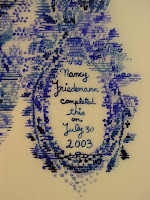
Detail of Byzantine Grid

Byzantine Grid is a traditional brocade, except that instead of being woven, it has been painted with thousands of tiny strokes to imitate an aged piece of cloth. At 90 inches high by 180 inches wide, it’s larger than the wall of my bedroom. While it’s detail and delicacy cuaght my eye, I also like how the artist deconstructs a ‘feminine’ art and remakes it as a fine art piece.

It makes a statement as it hangs in the gallery, one about women remaking patriarchal tradition in their own, modern way to create an object that demands to be placed next to the Jackson Pollacks of the world. Friedmann deconstructs traditionally feminine crafts of lace making and fabric, even while playing into traditional ideas of the feminine. These images of Friedmann’s work are from 2003, but she has more recent work based on fabrics on her website. Check out the small works from 2005.


She Muttered, 2003
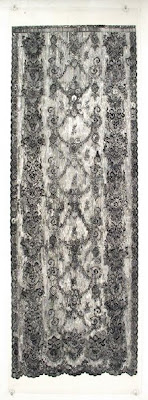
According to the artist, “I manipulate symbols that deal with ideas about femininity and the role of women in art history. I draw and paint and present these issues in an over the top gorgeous way. Among some of my interests are Spanish colonial art and Minimalism. I paint some of the things that women have been historically associated with, like flowers lace and embroidery. I monumentalize them and give them a heroic place and scale that can remind one of high macho modern art.”

Friedmann is hardly the only feminist who has reclaimed textiles as part of the fine arts. Along with many of the decorative arts, textiles have come to the forefront as ignored crafts with a visual language that has been ignored up until recently. The new Museum of Art and Design at Columbus Circle would hardly have been possible without this emergence. My posts have a bit of a feminist slant lately, but only because you see these things everywhere once you start looking. And by things, I mean beautiful and interesting objects and people.

Detail of She Muttered, 2003

Fashion Saves Economy

Christian Dior, couture 2009. Similar to images in recent posts, this dress is not recession-friendly.

This is a classic example of a patently untrue headline written to get attention, and lure the reader into the rest of the article. Fashion, despite the importance it gives itself, not to mention our necessity for clothes, could not save the economy alone, and the tents going up in Bryant Park and across the city for New York Fashion Week are certainly not going to do so. But don’t tell that to the designers or newspapers.

Reading fashion week coverage, the recession is on everyone’s (including Diane Von Furstenberg’s) lips. While saying times are tough, designers are also saying that they are necessary to a vibrant economy, that they create jobs, that it is always important for a woman to look and feel beautiful. Sorry designers, this may be a recession without breadlines, but that doesn’t mean people are buying couture.

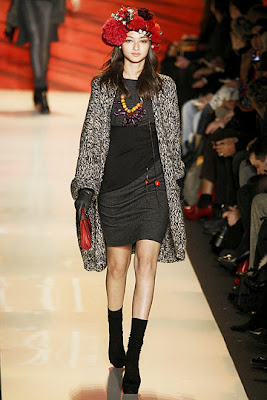
Von Furstenberg’s vision of recession

The thing is, I believe them on a certain level. A recession influences style, both larger trends and what an individual can afford to wear, but it also doesn’t take away a person’s interest in looking good. The need for beauty hasn’t dimished.

From the other side of the tracks, art has been claiming style as it’s own as a result of the recession. The confluence of fine art and fashion, much like art and advertising, is not new. But only recently have I heard someone say that,

“I think I represent the future of contemporary art and the synthesis of so many worlds that include contemporary art, like fashion. We can try taking it into the wider reaches of our culture in general, making it more accessible”

as the young Nicola Vassell does in a recent New York Times article. I have mixed feelings about the synthesis of fashion and fine art. Fine art has never been married to practical concerns of life and daily wear and tear, and a beautiful dress has never moved me like a beautiful painting.

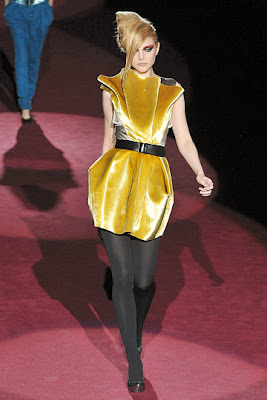
Marc Jacob’s recession chic

On the other hand, the intersection of life and art is fascinating, and fashion is an excellent example of that. The New York shows have a lot to deliver if they plan on saving the economy, beautifying women, and retaining the art to their fashion on a budget. For coverage of the shows, click here and the excellent commentary of Suzy Menkes click here. Let me know what you think about fashion as art.

Resistance and Success: Career Portraitist Le Brun

Self-portrait, Paris, 1782 (27 years old)

Resistance and success came in tandem to Le Brun as a female painter in French fin de siecle society. The daughter of a portraitist, Louise-Elisabeth Vigee-Le Brun (1755- 1842) was painting portraits professionally in her early teens from her parent’s home. As this was illegal without a license, Le Brun had to publicly apply for license and the French Academy (unwillingly) had to display her works as part of the process. This was in 1774, when Le Brun was 19 and a year before she married a painter and art dealer who would help her rise. Soon Le Brun found more success than resistance, as Marie Antoinette invited her to court to paint her portrait. The Queen’s invitation laid the foundation for Le Brun’s great success as the portrait painter of her day.

Self-Portrait with Daughter, Paris, 1789 (34 years old)


Le Brun’s skilled, Rococo style and personal warmth pleased the Queen so much that Le Brun was commissioned to paint many at the royal court. In 1783, Le Brun and another woman were both admitted as members of the French Academy (although only through the political pressures of the Queen).

Self-Portrait, Russia, 1800 (45 years old)


The French revolution upset all social order, and Le Brun fled the country. She spent years painting the heads of state of Italy, Russia, and Austria. Then, Napoleon welcomed her back to France, and Le Brun remained an active painter well into her older years, painted over 800 paintings and wrote memoirs that provide a glimpse into how artist’s were trained. She lived to be 87 years old, and is as remarkable for steady production of work as well as her rise and fall with the tides of national fortune. All the more remarkable for doing it as a woman
.

Self-Portrait, 1808, Paris, 56 years old